Yes. To pass FMGE in 2026 you need 150 marks out of 300, which is 50%. That is the only condition. If you score 150, you pass. If you score 149, you do not. There is no rank, no relative cutoff and no grace mark that can change this.
Sounds simple, right? It is, on paper. But after every session, the same questions fill up FMG WhatsApp groups. "Is 150 enough or do I need a buffer?" "Will NBEMS give grace marks because the paper was tough?" "Does the cutoff go down if fewer people pass?" This guide answers all of them, using NBEMS rules and real numbers from recent sessions, so you know exactly where you stand while you wait for the October 2026 result.
On this page
FMGE Exam Pattern and Where 150 Comes From
The Foreign Medical Graduate Examination is a screening test conducted by the National Board of Examinations in Medical Sciences (NBEMS). It checks whether a doctor who studied medicine abroad meets the minimum standard to practise in India. It is not a competitive entrance exam, and that difference explains everything about how it is scored.
| Feature | Detail |
|---|---|
| Total questions | 300 multiple-choice questions |
| Parts | Two parts of 150 questions each |
| Marks per correct answer | 1 |
| Negative marking | None |
| Total marks | 300 |
| Qualifying marks | 150 (50%) |
| Result format | Pass or Fail |
Because it is a screening test, the pass mark is fixed as a percentage of the total, not as a position in a merit list. You are not competing against the tens of thousands of other candidates. You are competing against one number: 150.
Passing FMGE makes you eligible to apply for provisional or permanent registration with the National Medical Commission (NMC) or a State Medical Council, depending on your internship status.
How NBEMS Decides Your FMGE Result
Here is the whole process, in plain words. NBEMS marks each of your 300 answers against its final answer key, adds one mark for every correct answer, and checks whether the total is 150 or more. That is it. A few rules shape how this works in practice.
- No negative markingA wrong answer and a blank answer both earn zero. This is why every coach tells you never to leave a question unanswered. A guess can only add to your total, never subtract from it.
- No grace marksThis is the rule students most want to be untrue. When a paper feels hard, rumours start that NBEMS will add marks or lower the bar. It does not. The pass mark stays at 150 whatever the difficulty. If NBEMS finds a wrong or ambiguous question, it can correct that question in its final key, but that is a correction, not a gift.
- No part-wise pass markYou do not need to pass Part I and Part II separately. Only your combined score out of 300 counts, and NBEMS does not publish separate marks for each part. So a strong Part II can make up for a weak Part I.
- No re-evaluationThere is no rechecking or re-evaluation of FMGE answers once the result is out. From this session, though, NBEMS is giving candidates a response sheet that shows every question ID with its correct answer, which at least lets you see where your marks went.
- The result is finalThe result is declared after the answer key is finalised, and it cannot be challenged afterwards.
So, Is 150/300 Really Enough?
For the result itself, yes, completely. A candidate with 150 and a candidate with 250 both get the same outcome: a pass, and the same eligibility to move on to internship and registration.
But there are two good reasons not to aim for 150.
- Your estimate is not your score. Most students judge their result from memory and recall questions after the exam. Memory is unreliable after a 300-question day, and recall keys shared online are sometimes wrong. A candidate who "counted 155" can easily land at 145 once the final key is applied. That is why borderline estimates are so stressful, and why you want a margin.
- The paper can be harder than you planned for. In June 2026, the pass percentage fell to around 12%, roughly half of the session before. If your plan was to scrape through on an average paper, a session like that leaves no room.
Many mentors tell candidates to prepare to score 170 to 180 in grand tests before the exam. That cushion of 20 to 30 marks absorbs a tough paper, a few silly mistakes and the gap between how you think you did and how you actually did.
What a Borderline Score Really Means
| Your estimated score | What it usually means |
|---|---|
| 165 or more | Very likely through, even if your estimate is a little generous |
| 150 to 164 | Borderline. Could go either way once the official key is applied |
| 135 to 149 | Possible but unlikely. Start planning for the next session quietly |
| Below 135 | Treat this as a preparation gap, not bad luck |
FMGE Pass Percentage in Recent Sessions
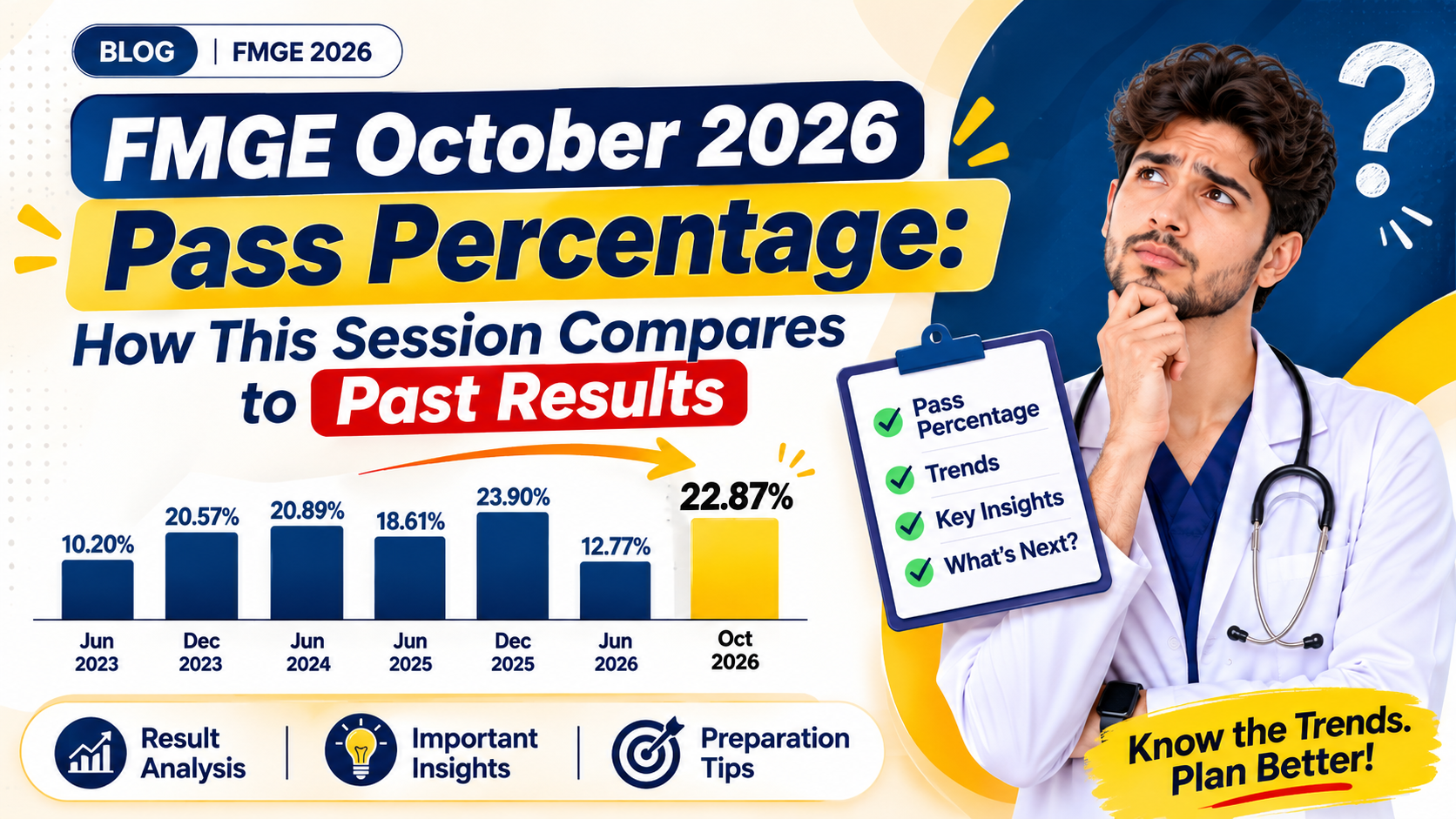
The pass mark has stayed at 150 for years, yet the share of candidates who reach it swings a lot from one session to the next. That swing comes from the paper and the batch, not from any change in the rule.
| Session | Appeared | Passed | Pass percentage |
|---|---|---|---|
| June 2026 | about 36,300 to 37,448* | 4,635 | about 12.4% |
| December 2025 | 42,872 | 10,264 | about 23.9% |
| June 2025 | 36,039 | 6,707 | 18.61% |
| December 2024 | 45,552 | 13,149 | 28.86% |
| June 2024 | 35,819 | 7,233 | 20.19% |
Two details from the June 2026 session are worth knowing. After the low result, the government told Parliament that about 88% of candidates were repeaters, and that the pass rate among first-time candidates was above 35%. In other words, the overall percentage hides a big difference between freshers and repeat candidates. If you are writing FMGE for the first time with a solid plan, your odds are much better than the headline number suggests.
How to Estimate Your FMGE Score Before the Result
If you wrote the October 2026 exam and cannot stop thinking about it, an honest estimate is better than guessing. Here is a simple method.
List the questions you are sure about
Go subject by subject and write down the questions you remember clearly and are confident you got right. Count them. This is your floor.
Add the likely ones at half value
For questions you remember but are only fairly sure about, count each one as half a mark. This allows for the ones you got wrong without realising.
Estimate the rest by subject
For each subject, think about how the section felt overall. If you usually score 60% in that subject in grand tests and the section felt normal, apply that rate to the questions you cannot remember.
Subtract a safety margin of 5 to 10 marks
Memory after a long exam tends to be generous to us.
Compare with 150
Use the borderline table above to see where you fall.
Watch our FMGE October 2026 paper analysis video to compare your answers with a subject-wise breakdown of the paper. And do not lose sleep over unofficial answer keys posted online. Only the final NBEMS key decides your score.
After the Result: Scorecard, Certificate and Next Attempt
NBEMS publishes the result on natboard.edu.in as a PDF. Your individual scorecard comes a little later through your NBEMS login. In the June 2026 session, the result came on 7 July and scorecards from 16 July. For a fuller breakdown, see our guide on the FMGE scorecard vs pass certificate.
If you passed, watch for the pass certificate schedule. Certificates are handed out in person after identity and document verification. For the December 2025 session, NBEMS said candidates had to collect them within six months of the result, or their result would be cancelled. Do not leave this to the last month.
If you scored below 150, the gap on your scorecard tells you what kind of plan you need. Missing by 5 marks calls for sharper revision and more grand tests. Missing by 40 calls for rebuilding weak subjects. The next session is expected in January or February 2027, which gives you roughly three months. A structured final push, like our FMGE 45-Day Rapid Revision Plan, can help you organise it.
Want a plan built around your scorecard?
FMGE Boosters offers 1:1 mentorship for FMGs, with a personal plan, daily tracking and a mentor who reviews every grand test with you. Your first grand test is free.
Explore FMGE BoostersFrequently Asked Questions
What are the FMGE passing marks for 2026?
You need 150 out of 300 marks, which is 50%. This applies to every FMGE session in 2026, including October 2026.
Is there negative marking in FMGE?
No. A wrong answer and an unanswered question both get zero, so attempting every question can only help your score.
Does NBEMS give grace marks in FMGE?
No. The pass mark stays at 150 regardless of how difficult the paper was. NBEMS can correct a faulty question in its final answer key, but it does not add grace marks or lower the cutoff.
Do I need to pass Part I and Part II separately?
No. Only your total score out of 300 matters. NBEMS does not set a separate pass mark for each part.
Is FMGE 150 marks enough to pass?
Yes. A score of exactly 150 is a pass. However, because self-estimates are often off by 5 to 10 marks, aim for 170 or more in practice tests to stay safe.
What was the FMGE pass percentage in 2026?
About 23.9% for the December 2025 session (held in January 2026) and about 12.4% for June 2026. The October 2026 figures will come with its result, due by 30 November 2026.
Can I apply for re-evaluation if I miss by a few marks?
No. FMGE has no re-evaluation. The result is final once declared.
150 is a clear line, and that is good news. It means you are not fighting for a rank or hoping others do worse. You only need to cross one number. Aim well above it, prepare with full-length tests, and the line takes care of itself.
Sources
- National Board of Examinations in Medical Sciences (official), natboard.edu.in
- National Medical Commission
- Physics Wallah: FMGE passing marks 2026 and June 2026 statistics
- Careers360: FMGE pass percentage by session
- Medical Dialogues: FMGE December 2025 and past session statistics
- Medical Dialogues: 88% repeaters, 35% fresher pass rate in June 2026
- AglaSem: FMGE result rules and scorecard
- FMGE Prep: pass mark, grace marks and re-evaluation
- Telangana Today: NBEMS reforms and response sheets

Dr. Yashaank
Founder of FMGE Boosters, mentoring foreign medical graduates through FMGE preparation with structured revision, mock tests, and exam-focused guidance. The FMGE Boosters team explains the real NBEMS rules so candidates know exactly where they stand.