If Community Medicine feels like an endless list of health programmes, national targets, vaccines, committees, and statistics, you are not alone. Most FMGE aspirants struggle with Preventive and Social Medicine because there is simply too much to remember. The good news is that you do not need to memorise every page of your PSM textbook to score well.
What to revise first, in short
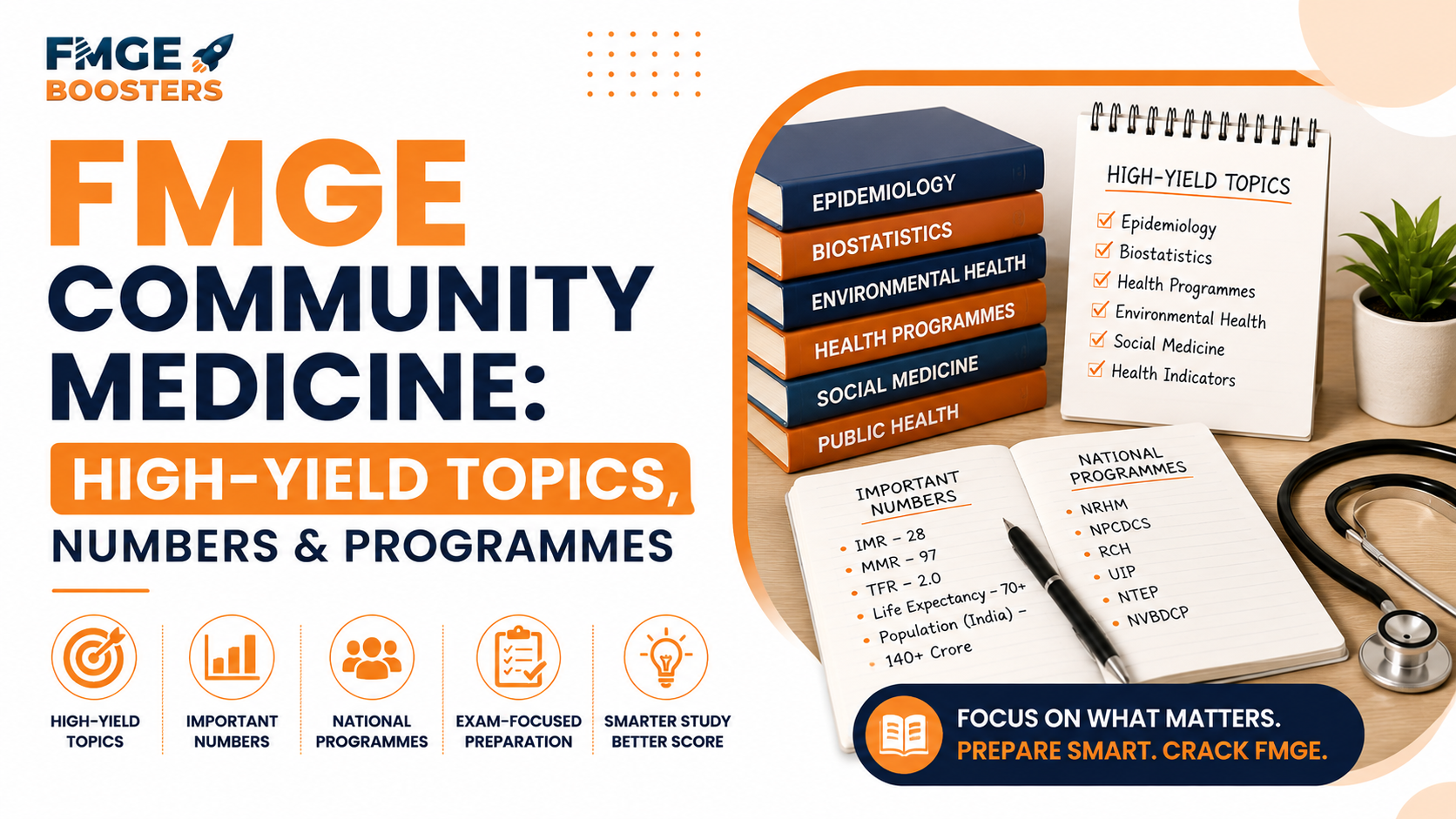
Community Medicine is a revision-heavy, high-scoring subject. Prioritise epidemiology and biostatistics, the major national health programmes (NTEP, UIP, NACP, NP-NCD), and the key health indicators (IMR, MMR, TFR, CBR, CDR). Learn each concept in context, understanding where it is applied, and practise previous-year questions to turn PSM into reliable marks.
If you are still planning your overall preparation, start with our guide on the Most Important Clinical Subjects for FMGE to understand which subjects deserve the most attention. Based on previous FMGE trends, certain topics, health programmes, formulas, and important numbers appear repeatedly. Once you know where to focus, Community Medicine becomes one of the highest-scoring subjects in the exam. This guide reflects previous FMGE trends, so always refer to the official National Board of Examinations in Medical Sciences (NBEMS) notifications for the latest examination updates. Below, we walk through the high-yield topics to prioritise, the important numbers worth remembering, and the national health programmes that deserve your attention before exam day.
Why Community Medicine can help you score easy marks in FMGE
Many students underestimate Community Medicine because it is not as clinically oriented as Medicine or Surgery. That is often a mistake. Community Medicine rewards consistent revision more than conceptual complexity. Once you have understood the core concepts and revised the repeatedly tested facts, answering PSM questions becomes much easier.
The subject combines theory with practical public health concepts. Questions commonly test your understanding of epidemiology, biostatistics, screening tests, vaccination, national health programmes, nutrition, environmental health, occupational health, demography and health planning. Another advantage is that many questions are direct: if you have revised the relevant programme, formula, or health indicator, you can often answer without lengthy clinical reasoning.
That said, do not fall into the trap of memorising isolated facts. FMGE increasingly tests whether you understand when and where these concepts are applied. Instead of asking only about a vaccine schedule, the paper may ask which programme it belongs to, who the target population is, or what health objective it supports. So while numbers matter, understanding the context matters just as much. If you have already solved previous FMGE papers, you will have noticed that several Community Medicine themes keep returning in different forms, and that is exactly where your revision should begin.
High-yield Community Medicine topics you should revise first
Community Medicine has a vast syllabus, but not every topic carries the same weight in FMGE. Based on previous question trends, these are the areas to prioritise during revision.
| Topic | High-yield focus |
|---|---|
| Epidemiology | Study designs, screening tests, bias, disease measures |
| Biostatistics | Mean, median, SD, p-value, sampling |
| National Health Programmes | NTEP, UIP, NACP, NP-NCD |
| Health Indicators | IMR, MMR, TFR, CBR, CDR |
| Environmental Health | Water, waste management, vector control |
Epidemiology
One of the most consistently tested sections, usually through application-based MCQs rather than direct definitions. Be comfortable with:
Epidemiology essentials
- Incidence and prevalence
- Relative risk and odds ratio
- Attributable risk
- Types of epidemiological studies
- Bias and confounding
- Screening tests
- Sensitivity and specificity
- Positive and negative predictive values
- Levels of prevention
- Disease surveillance
Biostatistics
Many aspirants avoid biostatistics because of the calculations. In reality, FMGE usually focuses on understanding concepts rather than lengthy mathematical problems. Spend enough time understanding when each statistical test is used instead of memorising formulas alone. Revise:
Biostatistics essentials
- Mean, median, and mode
- Standard deviation
- Normal distribution
- Confidence interval
- P value
- Types of errors
- Correlation and regression
- Sampling methods
Screening and prevention
Screening is another favourite FMGE area, often combined with national programmes and disease-control strategies. Focus on:
Screening and prevention essentials
- Wilson and Jungner criteria
- Characteristics of an ideal screening test
- Types of prevention
- Primordial, primary, secondary and tertiary prevention
- Mass versus selective screening
- Opportunistic screening
Demography and health indicators
Many of these indicators are easier to remember when you revise them together rather than individually. Expect questions on:
Demography essentials
- Fertility indicators
- Mortality indicators
- Infant mortality rate
- Maternal mortality ratio
- Total fertility rate
- Crude birth rate and crude death rate
- Dependency ratio
- Population pyramid
Environmental and occupational health
Do not skip these chapters during your final revision; several of these topics have appeared repeatedly in previous FMGE papers. Pay special attention to:
Environmental and occupational essentials
- Water purification and chlorination
- Air pollution
- Biomedical waste management
- Noise pollution
- Radiation hazards
- Occupational diseases
- Ergonomics
- Vector control measures
High-yield national health programmes you must know
Ask any FMGE topper about Community Medicine and you will hear the same advice: do not ignore the National Health Programmes. They appear regularly, sometimes as direct questions and sometimes as case-based MCQs. Instead of memorising every detail, focus on the objective, target population, important interventions, and key components of each programme. Looking at the Previous Year FMGE Trends can also help you identify which programmes have been tested repeatedly. Based on previous trends, these deserve the highest priority.
National Tuberculosis Elimination Programme (NTEP)
One of the most frequently tested programmes, often integrating microbiology and pharmacology concepts. Revise programme objectives, case definitions, diagnostic methods, drug-sensitive and drug-resistant TB, the Nikshay portal, active case finding, contact tracing, and preventive therapy.
Highest priorityUniversal Immunisation Programme (UIP)
Vaccines remain a favourite FMGE topic. Know the National Immunisation Schedule, live and killed vaccines, vaccine storage, the cold chain, the vaccine vial monitor, adverse events following immunisation, the open vial policy, and vitamin A supplementation. Revise vaccines alongside UIP so you understand their public health context.
Highest priorityNational AIDS Control Programme (NACP)
Focus on HIV prevention strategies, PPTCT services, HIV testing algorithms, ART services, high-risk groups, sentinel surveillance, and targeted interventions. Many questions combine HIV epidemiology with programme implementation.
High priorityNational Programme for Prevention and Control of Non-Communicable Diseases (NP-NCD)
Non-communicable diseases continue to gain importance. Revise screening recommendations, target diseases, risk-factor modification, community and population-based screening, and Health and Wellness Centres.
High priorityDo not neglect these programmes during your final revision either. You do not have to memorise every operational guideline; concentrate on the objective, target beneficiaries, important services, and recent updates where applicable.
Other programmes worth revising
- National Leprosy Eradication Programme
- National Vector Borne Disease Control Programme
- National Viral Hepatitis Control Programme
- National Mental Health Programme
- National Programme for Health Care of the Elderly
- National Tobacco Control Programme
- Rashtriya Bal Swasthya Karyakram
- Rashtriya Kishor Swasthya Karyakram
- Anaemia Mukt Bharat
- POSHAN Abhiyaan
Important numbers, formulas and health indicators
Community Medicine is famous for making students memorise numbers. Fortunately, FMGE does not expect you to remember every statistic ever published. Instead, it repeatedly tests a relatively small group of formulas, indicators, and classifications. During your final revision, make sure you are confident with the following.
Epidemiological measures
Revise the calculation and interpretation of incidence, prevalence, attack rate, secondary attack rate, relative risk, odds ratio, attributable risk, and population attributable risk. Understanding when to use each measure is more important than memorising the formula alone.
Mortality and fertility indicators
Questions frequently revolve around IMR, neonatal mortality rate, under-five mortality rate, maternal mortality ratio, perinatal mortality rate, crude birth rate, crude death rate, general fertility rate, and total fertility rate. Do not just learn definitions; practise identifying which indicator best reflects a given public health scenario.
Nutrition and growth standards
Nutrition is another high-yield area. Revise body mass index, WHO growth charts, mid-upper arm circumference, protein-energy malnutrition, vitamin deficiency disorders, recommended dietary allowances, and indicators of nutritional assessment.
Important classifications
Keep a separate one-page sheet for classifications such as the iceberg phenomenon, levels of prevention, modes of disease transmission, the disaster management cycle, biomedical waste categories, family planning methods, oral rehydration therapy, and health education principles. These may look simple, but they are often the difference between a correct and incorrect answer. A practical approach is to maintain a dedicated notebook for numbers, formulas, and health programmes, and revisit it during the final week before FMGE to save valuable revision time.
How FMGE asks Community Medicine questions
Community Medicine questions in FMGE are rarely about recalling an entire chapter word for word. More often, they test whether you can apply basic public health concepts to a practical scenario. Instead of asking you to define a study design, the exam may describe a research scenario and ask you to identify the most appropriate one. Similarly, a question on a national health programme may focus on its objective, target population, or key intervention rather than its complete operational details. Previous FMGE papers show that epidemiology, screening tests, vaccination, nutrition, demography, environmental health, and national health programmes are tested repeatedly in different ways.
As you revise, do not just memorise facts. Try to understand where a concept is used and how it could appear as an MCQ. Before moving on from Community Medicine, make sure you have revised epidemiology and biostatistics, screening tests and levels of prevention, national health programmes, immunisation and vaccine-related concepts, nutrition and health indicators, environmental and occupational health, and previous-year FMGE questions from high-yield topics.
Ready to simplify your PSM revision? Download the PSM Quick-Revision Sheet from FMGE Boosters and keep all the high-yield topics, important numbers, and national health programmes in one place for your final FMGE revision.
Get the PSM Quick-Revision Sheet