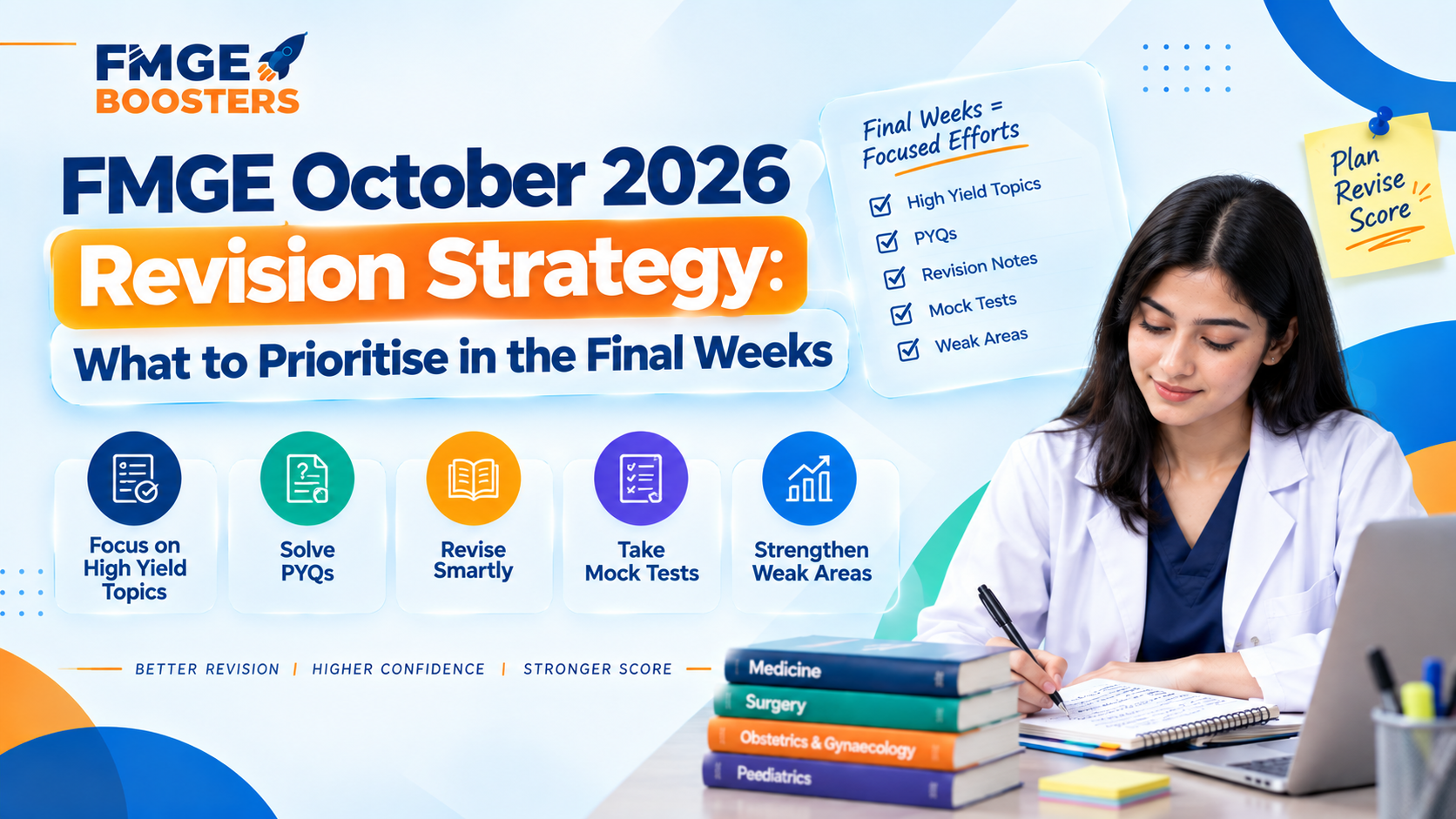
The final weeks before FMGE are not the time to treat every subject equally. With the FMGE October 2026 examination scheduled for 31 October 2026, you now have a fixed deadline to work towards, and every hour should go to the areas that actually need your attention.
The strategy, in short
Start from the official blueprint (Medicine, Surgery, OBG and Community Medicine alone carry 125 of 300 marks), then let your own MCQ and mock performance decide where extra time goes. Make MCQs part of revision, keep an error log, and practise under timed, section-restricted conditions. In the last days, consolidate rather than adding new material.
The October 2026 Information Bulletin gives you a useful starting point. The examination will consist of 300 multiple-choice questions divided into two parts of 150 questions each. Each part has a total allotted time of 153 minutes, including additional time provided for manual and digital attendance and verification. The paper will also have time-restricted sections: you cannot move ahead before the allotted time for a section ends, and once a section closes, you cannot return to it or modify your responses. So your final revision strategy needs to do more than help you cover the syllabus. It needs to help you decide what deserves your time, test how well you can recall it, and identify the mistakes you still make under pressure.
Start with the official FMGE blueprint
Before you decide what to revise today, look at where the marks come from. The FMGE October 2026 Information Bulletin provides the official subject-wise distribution for the 300-mark FMGE, dividing the examination into 100 marks from pre- and para-clinical subjects and 200 marks from clinical subjects. That distribution should form the foundation of your revision plan.
| Subject | Marks |
|---|---|
| Anatomy | 17 |
| Physiology | 17 |
| Biochemistry | 17 |
| Pathology | 13 |
| Microbiology | 13 |
| Pharmacology | 13 |
| Forensic Medicine | 10 |
| Total | 100 |
| Subject | Marks |
|---|---|
| Medicine | 33 |
| General Surgery | 32 |
| Obstetrics and Gynaecology | 30 |
| Community Medicine | 30 |
| Paediatrics | 15 |
| Ophthalmology | 15 |
| Otorhinolaryngology (ENT) | 15 |
| Psychiatry | 5 |
| Dermatology and STD | 5 |
| Radiotherapy | 5 |
| Anaesthesiology | 5 |
| Orthopaedics | 5 |
| Radiodiagnosis | 5 |
| Total | 200 |
The numbers immediately show where a larger share of the paper comes from. Medicine carries 33 marks, General Surgery 32, while Obstetrics and Gynaecology and Community Medicine carry 30 each. Together, these four subjects account for 125 marks. That does not mean you should ignore the smaller subjects; it means the time you give each subject does not have to be identical. Your own performance matters just as much: if you consistently score well in Medicine but keep making mistakes in Pharmacology, spending another three hours reading Medicine may not be the most productive use of your time. Use the official blueprint to understand the distribution, then use your MCQ performance and mock-test analysis to decide where you need to work harder. For a detailed breakdown of the syllabus and subject-wise distribution, read our FMGE Syllabus: Subject-Wise Distribution and Important Topics.
Prioritise high-yield areas within each subject
Once you understand the subject-wise distribution, the next step is deciding what to revise within each subject. You do not need to give every chapter the same amount of attention during the final stretch. Start with the topics you have already studied and divide them according to your level of recall: some will come to you immediately, others may look familiar when you read them but become difficult to recall in an MCQ, and some are topics where you keep making the same mistakes despite revising them before. The last two categories deserve more attention.
This is where active revision becomes more useful than simply reading your notes again. After revising a topic, test yourself: can you recall the important facts without looking at your notes, differentiate between similar clinical conditions, and identify the correct investigation or management step when the information is presented as an MCQ? If the answer is no, that topic needs another revision cycle. For high-weightage subjects, focus on the areas that repeatedly appear in your question practice and the concepts you continue to get wrong. For smaller subjects, use concise revision material and focus on important concepts rather than studying every topic in the same depth. Your aim should be to improve the amount of information you can recall quickly, not the number of pages you can read.
Make MCQs part of your revision
During the final weeks, MCQs should not become something you do only after completing your revision. They should be part of the revision itself. The bulletin states that the examination will consist of 300 multiple-choice questions, with four response options for each, no negative marking, and a qualifying requirement of at least 150 marks out of 300. That makes question practice particularly useful during the final stretch, since you can use MCQs to check whether your revision is actually translating into recall.
But do not judge your preparation only by the number of questions you solve. A wrong answer can point towards a knowledge gap, poor recall, confusion between similar options, or a failure to recognise the concept being tested, and a correct answer that you guessed may also show that the topic needs another round of revision. Keep a simple error log and record recurring mistakes; over time this becomes one of your most useful revision resources, because it shows exactly where your preparation continues to break down. For a more detailed approach to question practice, read our How to Solve FMGE MCQs: A Practical Approach. The goal is not to solve the largest possible number of MCQs; it is to learn from the questions you solve.
Use mock tests to train for the October exam
Mock tests become increasingly useful as the examination gets closer, but only if you analyse them properly. A mock test should tell you more than your final score. After every test, review the questions you got wrong, the questions you guessed, and the questions that took unusually long to solve, and look for patterns in your mistakes. If you repeatedly lose marks in one subject, that subject needs another revision cycle. If you know the concept but regularly confuse two options, focus on differentiating those concepts. If you understand the material but take too long to answer, you need more timed question practice.
Train for the section-restricted format. The bulletin explains that each part of the paper will contain time-restricted sections: candidates cannot proceed to the next section before the allotted time ends, and cannot review or modify responses from a section after its time has expired. So your practice should include timed question-solving, so you become comfortable making decisions within a fixed time instead of spending several minutes on one difficult question.
For example, if you are revising a subject and solving a question set, give yourself a defined time limit, notice which questions slow you down, and then work on improving both recall and decision-making. Most importantly, analyse your mock before moving on to the next one. One well-analysed test can be more useful than several tests you complete without reviewing your mistakes.
Plan the final weeks around revision, recall and mistake correction
Your revision should become progressively more focused as 31 October approaches. If you have already completed most of the syllabus, use this period to strengthen recall, solve MCQs and work through your mistakes. If you still have significant portions left, divide your remaining syllabus according to the official blueprint and your current performance instead of attempting to study everything with equal depth. A practical revision cycle can look like this.
| Study stage | What to focus on |
|---|---|
| Revision | High-priority subject or weak topic |
| Question practice | MCQs based on the topic revised |
| Analysis | Incorrect, guessed, and time-consuming questions |
| Recall | Short notes, important facts, and recurring mistakes |
| Revisit | Topics where the same mistakes continue to appear |
You do not need to follow this structure by the clock; the important part is that these activities work together. If you spend one session revising Medicine, use MCQs to test that revision, and if the questions reveal a weak area, add it to your mistake list and revisit it later. This creates a continuous cycle of revision, testing and correction instead of keeping each activity separate. You should also revisit previously studied topics rather than relying on one final revision before the exam, since spaced revision and active recall help you retain information more effectively. Our FMGE 45-Day Rapid Revision Plan for the Final Stretch also focuses on structured revision, MCQ practice, mock tests and mistake analysis, and you can use it as a reference to organise the remaining period.
As the examination gets closer, reduce unnecessary new material. The final days should focus mainly on consolidation: revise your short notes, error log, important facts, previously marked questions, and topics where you continue to make mistakes. Continue solving MCQs, but avoid turning every remaining day into a full-length mock-test marathon. Do not suddenly add several new resources because you see someone recommending them online; if a resource has not been part of your preparation so far, consider whether it will genuinely improve your revision or simply give you another unfinished list. Your final revision should feel familiar: you should be strengthening what you know, correcting what you get wrong, and making recall faster.
The bottom line
The FMGE October 2026 examination is scheduled for 31 October 2026, and the official Information Bulletin gives you a clear picture of the examination structure, subject-wise blueprint, and time-restricted format you need to account for. Use that information to make your final revision more targeted: start with the official subject-wise distribution, then combine it with your own MCQ and mock-test performance. Give more attention to high-weightage subjects and recurring weak areas, while using shorter revision methods to keep smaller subjects active. Make MCQs part of your revision, analyse your mistakes instead of only checking scores, and practise under timed conditions so the exam format does not feel unfamiliar. You do not need to study everything again; you need to make what you have already studied easier to recall, easier to apply, and more reliable under time pressure.
If you want a more structured approach to your final weeks, FMGE Boosters can help you plan your revision, track your preparation, practise with regular tests, and stay accountable with mentor support. Start your FMGE preparation with FMGE Boosters.
Start with FMGE Boosters