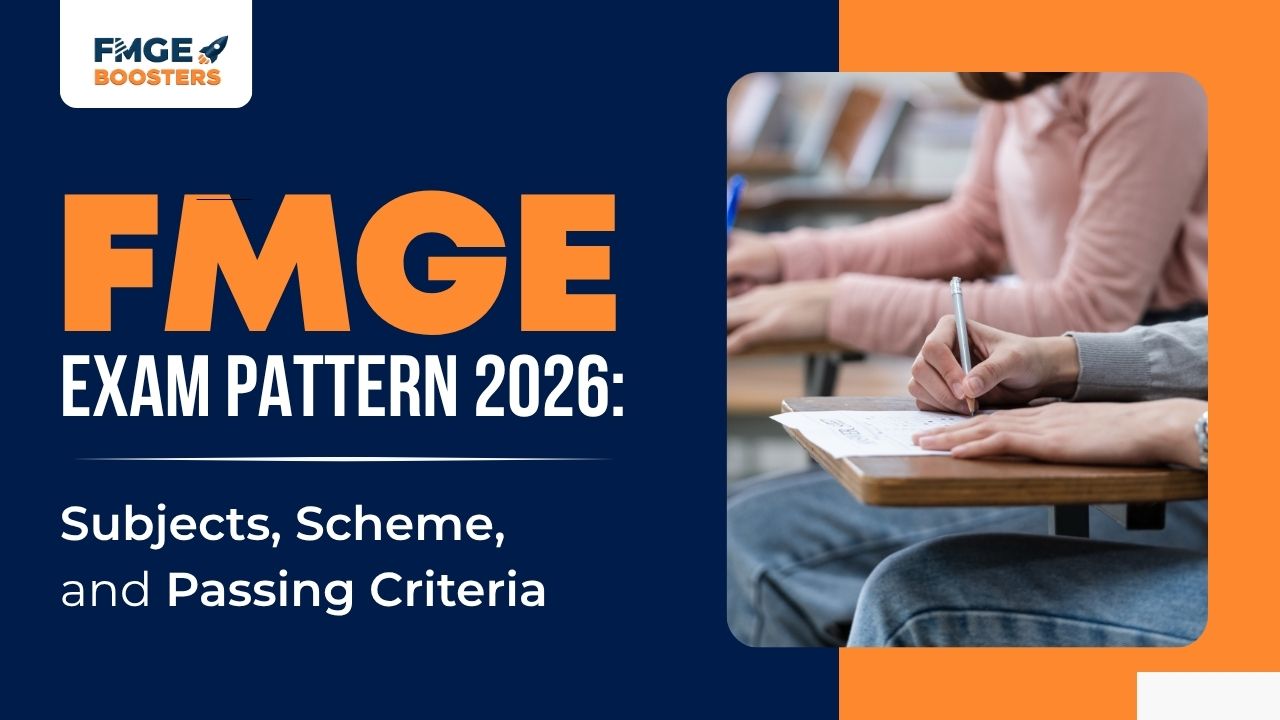
300 questions, one day, two papers. But do you actually know what happens inside the exam hall on the day of your FMGE?
Quick answer
FMGE 2026 is a 300-question computer-based test split into two papers, Part A and Part B, 150 marks each. There is no negative marking, and you need 150 out of 300 (50%) on aggregate to pass, with no sectional cut-off. The next exam is on 28 June 2026.
Most candidates spend months preparing but never sit down to fully understand how the paper works, and that is a mistake. Knowing the FMGE exam pattern 2026 in detail (the structure, the timing, the subject weightage and the marking scheme) is not just useful trivia. It directly shapes how you prepare, what you prioritise and how you perform on the day. So let us break it all down, clearly and simply, so there are no surprises on exam day.
What is the FMGE 2026 exam pattern and how is the paper structured?
FMGE 2026 is a computer-based test (CBT) conducted twice a year, in June and December, by the National Board of Examinations in Medical Sciences (NBEMS) under the National Medical Commission (NMC). The NMC sets the qualifying standard and NBEMS conducts the exam. The next exam is scheduled for 28 June 2026.
The paper has 300 MCQs in total, divided equally into Part A and Part B with 150 questions each. Both parts run on the same day in two separate shifts, with a break in between.
Every question carries 1 mark, and you get roughly 1 minute per question. That sounds manageable, but with a section timer running in the hall, a minute disappears fast. Each section is also time-bound (more on that below). Practising on screen, under timed conditions, is not optional. It is essential. You can verify all official details on the NBEMS website (natboard.edu.in).
What is the difference between Part A and Part B?
Part A and Part B are two separate sittings of the same 300-question paper, each with 150 questions worth 150 marks, held at different times of the day. Part A runs from 9:00 am to 11:30 am and Part B from 2:00 pm to 4:30 pm.
Here is what actually matters for preparation: across the full paper, the NBEMS blueprint allocates 100 marks to pre and para-clinical subjects and 200 marks to clinical subjects. That means two-thirds of the total marks come from clinical subjects, regardless of which part they appear in. If you are splitting study time equally between clinical and pre-clinical, you are not preparing strategically. This does not mean you ignore Part A. It means you go in knowing where the bigger battles are fought.
FMGE 2026 subject-wise weightage: where are the most marks?
Here is the complete subject-wise weightage, per the official NBEMS FMGE 2026 information bulletin.
| Subject | Marks |
|---|---|
| Anatomy | 17 |
| Physiology | 17 |
| Biochemistry | 17 |
| Pathology | 13 |
| Microbiology | 13 |
| Pharmacology | 13 |
| Forensic Medicine | 10 |
| Total | 100 |
Anatomy, Physiology and Biochemistry together account for 51 of the 100 pre/para-clinical marks. If you are short on time, cover the bases in these three at least.
| Subject | Marks |
|---|---|
| Medicine | 33 |
| General Surgery | 32 |
| Obstetrics & Gynaecology | 30 |
| Community Medicine | 30 |
| Paediatrics | 15 |
| Ophthalmology | 15 |
| Otorhinolaryngology (ENT) | 15 |
| Psychiatry | 5 |
| Dermatology & STD | 5 |
| Radiotherapy | 5 |
| Anaesthesiology | 5 |
| Orthopaedics | 5 |
| Radiodiagnosis | 5 |
| Total | 200 |
Medicine, General Surgery, Obstetrics & Gynaecology and Community Medicine together account for 125 of the 300 total marks, nearly half the paper from just four subjects. Get these right and you are more than halfway to your passing score before touching anything else. Paediatrics, Ophthalmology and ENT follow at 15 marks each: do not ignore them, but prioritise the top four first.
For a topic-level breakdown within each subject, see our guide: FMGE 2026 syllabus: high-weightage topics you can't ignore.
What is the FMGE 2026 marking scheme, and is there negative marking?
The marking is refreshingly simple: there is no negative marking in FMGE 2026. Every correct answer earns +1 mark and every wrong answer earns 0, with no penalty for getting one wrong.
Use this to your advantage
Attempt every single question. If you are stuck between two options, pick the one that feels more right and move on. An educated guess gives you a chance at a mark; a blank gives you none. Make sure all 300 questions have a response before you submit.
What are the FMGE 2026 passing marks and qualifying criteria?
The passing mark is a clear number: 150 out of 300, or 50%. The detail many candidates miss is that there is no sectional cut-off, so you do not need 50% in Part A and Part B separately. The 50% applies to your aggregate across both parts.
Strategically, that means a strong clinical score (clinical subjects carry 200 marks) can offset a weaker pre-clinical performance, as long as your combined total reaches 150. It is not licence to neglect Part A, but it is worth knowing when you plan your prep.
To see how candidates have historically performed against this cut-off, see our guide: FMGE pass percentage and cut-off trends.
What are FMGE 2026 time-bound sections and why do they matter?
This is a detail most candidates only discover on exam day, by which point it is too late to adjust. Both Part A and Part B are internally divided into time-bound sections, each with its own timer. Once a section's time runs out you cannot return to it, and you cannot jump ahead before it ends.
In practice, if you burn four minutes on one hard question in Section 1, you are stealing time from easier questions in that same section. When Section 1 closes, those unattempted questions are gone, which is exactly where well-prepared candidates lose marks they shouldn't.
How to approach a timed section
Scan the section quickly first to get a feel for what is there.
Answer the questions you are confident about first.
Flag the ones you are unsure about and come back to them.
Never spend more than 90 seconds on a single question in your first pass.
In your second pass, attempt every flagged question, even if you are guessing.
Before the timer ends, make sure every question has an answer marked.
The timed structure rewards disciplined time management, not just knowledge. If you have never practised under section-wise timed conditions, start now. The CBT experience is very different from solving on paper.
FMGE 2026 exam-day schedule: what does the full day look like?
| Session | Time |
|---|---|
| Part A: Pre & para-clinical | 9:00 am to 11:30 am |
| Break | 11:30 am to 2:00 pm |
| Part B: Clinical subjects | 2:00 pm to 4:30 pm |
The break between papers is 2.5 hours, long enough that most candidates underestimate its effect on Part B. Treat it as part of the exam:
- Eat something light, as your brain needs fuel for Part B.
- Do not rehash Part A with other candidates; it only breeds anxiety.
- Do a quick 20 to 30 minute review of your clinical high-yielders: Medicine, Surgery, OBG and Community Medicine.
- Rest for the remaining time, because mental fatigue in Part B is real.
How should the exam pattern shape your preparation strategy?
Knowing the format only helps if you let it change how you prepare. Three takeaways:
- Follow the weightage. Clinical subjects carry 200 marks, pre-clinical 100, so spend roughly two-thirds of your time on clinical and one-third on pre-clinical, adjusting for your own strengths.
- Exploit the no-negative-marking rule from day one. Always attempt every MCQ in practice so guessing intelligently becomes automatic on exam day.
- Rehearse on a CBT. Do at least 4 to 5 full mock papers under timed, section-wise conditions before 28 June 2026. The interface, timers and flagging system all take getting used to.
Finally, plan the day itself: know your centre, your timings and what you will do during the 2.5-hour break. Candidates who think through exam day consistently perform better in Part B.
Get the free FMGE Exam Pattern PDF
Structure, subject weightage, marking scheme and exam-day schedule, all on one page.
Download the PDF