Forty-five days may not seem like a lot of time. But when it comes to FMGE, these final weeks can have the biggest impact on your preparation. The difference between the students who thrive and the ones who panic is rarely how much they have studied. It is whether they have a clear plan.
The plan, in short
Build your 45 days around subject weightage. Spend the first two weeks on the highest-weightage subjects (Medicine, Surgery, OBG, Community Medicine), then cover para-clinicals and shorter subjects, and dedicate the final two weeks to revision, mock tests and mistake analysis. Solve MCQs daily, keep a mistake notebook, and in the last stretch strengthen recall rather than learning anything new.
Whether you have been preparing for months or you are only now getting serious about FMGE 2026, these next 45 days can still make a significant difference if you use them wisely. In this guide, we help you build a practical 45-day revision plan, prioritise subjects based on their weightage, and make the most of every day leading up to the exam. The goal is not to study everything again. It is to revise the right topics at the right time and walk into the exam with confidence.
Build your 45-day plan around the FMGE exam pattern and subject weightage
Before you decide what to study each day, it is important to understand how the FMGE is structured. A clear understanding of the exam pattern and subject weightage helps you prioritise your revision instead of giving every subject the same amount of time. According to the official FMGE blueprint published by NBEMS, the examination is conducted in two parts on the same day, with 150 MCQs in each paper. Part A covers the pre-clinical and para-clinical subjects, while Part B focuses on the clinical subjects. Each paper runs over 2.5 hours, giving you roughly one minute per question. Every correct answer carries one mark, there is no negative marking, and you need to score 150 out of 300 marks to qualify. For the latest updates on the pattern, eligibility and notifications, always refer to the NBEMS website.
Understanding the exam pattern is only one part of the equation. The next step is knowing where your marks are most likely to come from. Based on the official subject-wise distribution, the clinical subjects contribute 200 marks, while the pre-clinical and para-clinical subjects account for the remaining 100. Within these, Medicine, General Surgery, Obstetrics and Gynaecology, and Community Medicine carry the highest weightage, making them the natural starting point for your final revision.
| Subject | Marks |
|---|---|
| Anatomy | 17 |
| Physiology | 17 |
| Biochemistry | 17 |
| Pathology | 13 |
| Microbiology | 13 |
| Pharmacology | 13 |
| Forensic Medicine | 10 |
| Total | 100 |
| Subject | Marks |
|---|---|
| Medicine | 33 |
| General Surgery | 32 |
| Obstetrics and Gynaecology | 30 |
| Community Medicine | 30 |
| Paediatrics | 15 |
| Ophthalmology | 15 |
| Otorhinolaryngology (ENT) | 15 |
| Psychiatry | 5 |
| Dermatology and STD | 5 |
| Radiotherapy | 5 |
| Anaesthesiology | 5 |
| Orthopaedics | 5 |
| Radiodiagnosis | 5 |
| Total | 200 |
Rather than trying to study all 19 subjects with the same intensity, use this weightage as a guide to plan your revision. Prioritising high-weightage subjects early gives you enough time to revisit them before the exam while still covering the remaining subjects in a structured manner. If you are still creating your overall strategy, our FMGE Study Plan can help you build a structured timetable based on your available study time and revision goals.
Your 45-day FMGE revision plan
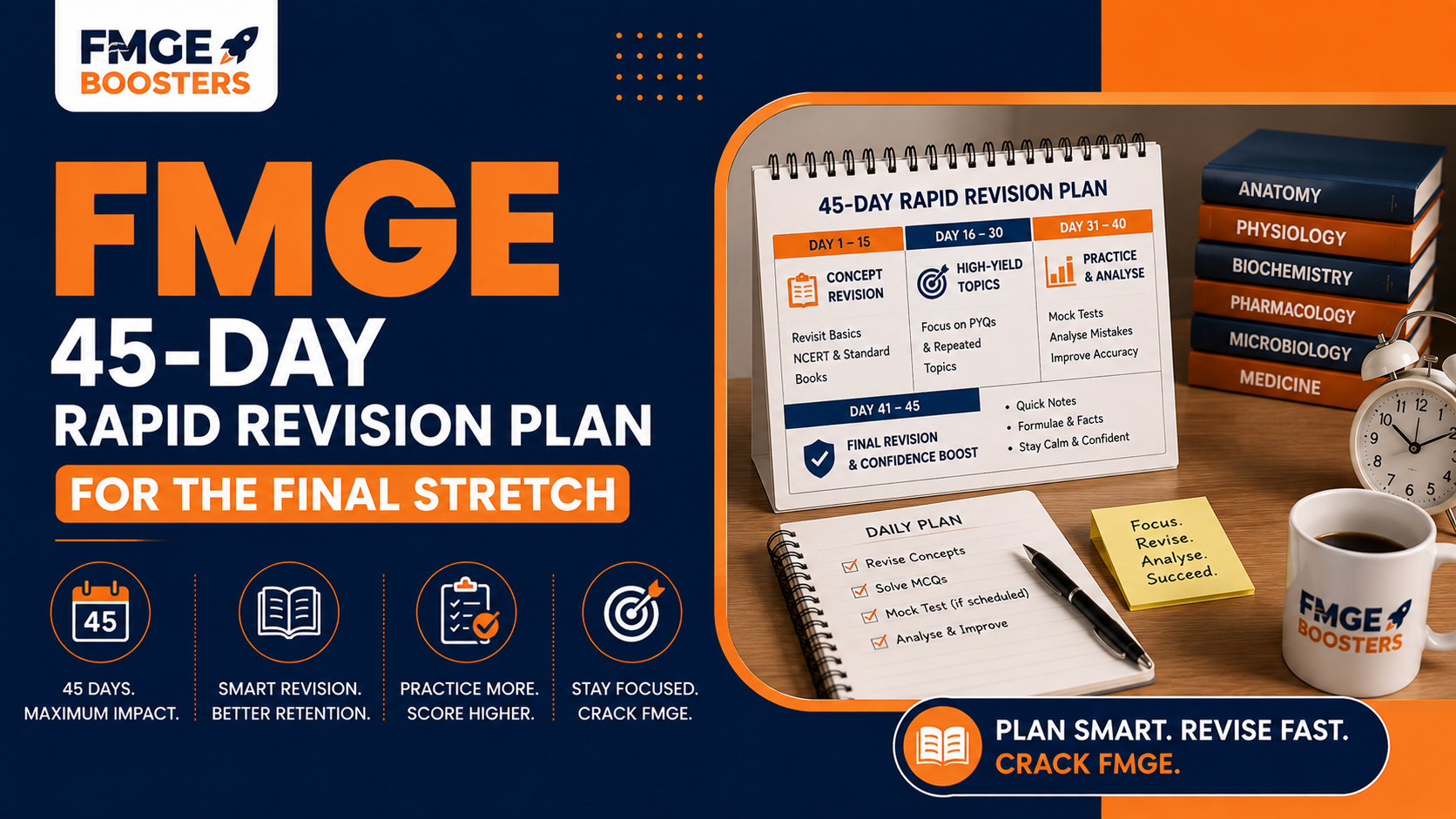
Now that you know how the marks are distributed, it is time to turn that information into a practical study plan. The idea is not to study every subject from scratch in the final 45 days. Instead, use this time to strengthen high-weightage subjects first, revise the remaining subjects systematically, and leave enough time for multiple rounds of revision and mock tests. Think of this plan as a framework rather than a rigid timetable; if you are stronger in one subject or need extra time for another, adjust it to suit your preparation.
| Days | Focus and MCQ target |
|---|---|
| Day 1-2 Planning | Go through the exam pattern and syllabus, decide your main reading source, and study the subject-wise weightage table to build your schedule. |
| Day 3-15 High-weightage subjects | Medicine (4 days), Surgery (4 days), OBG (3 days) and Community Medicine (3 days). At least 80 to 150 MCQs per day, including previous-year questions. |
| Day 16-23 Para-clinicals and mid clinical | Pathology, Pharmacology and Microbiology (2 days each), Paediatrics (1 day), and short clinical subjects such as ENT and Ophthalmology (1 day). 80 to 120 MCQs per day. |
| Day 24-28 Remaining subjects | Forensic Medicine (1 day), Anatomy (2 days), Physiology (1 day), Biochemistry and Radiology or Radiotherapy (1 day). 80 to 100 MCQs per day. |
| Day 29-34 Revision of all subjects | Revise notes across Medicine and allied, Surgery and OBG, PSM and Paediatrics, Pathology and Pharmacology, Microbiology and short subjects. Skim flowcharts and image-based questions. 120 to 150 MCQs per day. |
| Day 35-40 Targeted revision and mocks | Full-syllabus FMGE-pattern mock tests at real exam timing. Note all mistakes and guesses, do a subject-wise analysis, and revise your weakest subjects. |
| Day 41-44 Second mock and recall | Mock test 2 followed by mistake analysis and revision. Recall of high-yield subjects (Medicine, OBG, Surgery, PSM) and image-based questions. |
| Day 45 Rest day | Flashcards and light recall for no more than 2 to 3 hours. Prepare your admit card, ID proof and exam-centre details. Rest. |
Why this plan works
The first two weeks focus on the subjects that contribute the most marks, giving you enough time to revisit them later. The following phase covers the remaining high-yield subjects before moving on to shorter subjects and rapid revision. The final two weeks are dedicated almost entirely to revision, mock tests, mistake analysis, and image-based questions. By this stage, your focus should shift from learning new concepts to strengthening recall, improving accuracy, and building exam-day confidence.
How to make every study day count
A well-planned schedule is not just about deciding what to study. It is also about knowing when to study it. You do not have to follow a strict hourly timetable, but giving different tasks a dedicated time of day can make your revision more productive and prevent mental fatigue. Here is a simple routine you can adapt.
Learn and revise core concepts
Your mind is usually freshest in the morning, making it the best time to revise subjects that need deeper concentration. Use these hours to go through your notes, understand difficult concepts, and revise high-weightage topics before distractions build up.
Solve MCQs and apply what you studied
Instead of continuing to read for hours, switch to solving MCQs. This is the best way to test your understanding, identify weak areas, and improve your approach to case-based questions. Aim to review every incorrect answer instead of simply checking your score.
Review your mistakes
Every incorrect answer teaches you something. Spend time each evening revisiting the mistakes you made during the day, understanding why you got them wrong, and noting concepts that need another round of revision. A small mistake notebook can become one of your most valuable resources in the final week.
End the day with quick recall
Avoid starting a completely new topic just before bed. Instead, revise flowcharts, tables, one-liners, image-based questions, or topics you studied earlier in the day. A short recall session before sleeping helps reinforce concepts without adding unnecessary stress.
Remember, the goal is not to study for the longest number of hours. It is to stay consistent and make every study session purposeful.
Track your progress, not just your study hours
Studying for long hours does not always translate into better scores. What makes the biggest difference during the final 45 days is knowing where you are improving and where you are still losing marks. One of the simplest ways to do this is by making self-assessment part of your daily routine instead of waiting until the last week.
Four habits that build recall
- Revise regularly, not just once. Revisit a topic within 24 hours and again after a few days. This spaced revision strengthens memory and makes recall easier under exam pressure.
- Learn through MCQs. Reading alone will not tell you whether you have understood a topic. Solving MCQs helps you apply concepts, improve speed, and spot the areas that still need attention.
- Keep a mistake notebook. Record questions you got wrong, concepts you found confusing, and topics you guessed in mocks. Reviewing these prevents repeat errors and gives you a focused resource for the final week.
- Use mock tests to refine your strategy. Mocks help you manage time, identify weak subjects, and build stamina. After each one, spend as much time analysing mistakes as you spent attempting the paper.
During your final week, our FMGE One-Liners can also be a useful resource for quickly revising high-yield facts, frequently tested concepts, and important last-minute recall points.
Stay consistent until exam day
A 45-day revision plan is only useful if you follow it consistently. Do not worry if you fall behind on a particular day or need extra time on a difficult subject. The goal is not to complete a perfect timetable. It is to make steady progress every single day. Avoid comparing your preparation with someone else's, since every aspirant has different strengths, weaknesses, and study habits. If a subject needs an extra day or you have to adjust the schedule, that is perfectly fine. What matters is that you keep moving forward instead of losing momentum.
As the exam gets closer, resist the urge to start new resources or completely change your strategy. Trust the notes you have prepared, revise the topics you have already studied, solve enough MCQs to stay confident, and focus on strengthening your weak areas rather than trying to cover everything again. These final 45 days will not determine how intelligent you are. They will reflect how consistently you have used the time you had. Stay focused, trust your preparation, and keep showing up every day. Small, consistent efforts over the next six weeks can make a significant difference when you sit down to write FMGE 2026.
Ready to make the most of your final revision? Download our FMGE 45-Day Revision Planner and stay on track with a structured study schedule designed for the last stretch before the exam.
Download the 45-Day Planner