Every FMGE aspirant starts with the same goal: I just want to clear it in one attempt. Yet every year, thousands walk out knowing they studied for months and still could not cross the 150-mark line. It usually is not because they did not work hard. It is because they spent months studying without a strategy.
The strategy, in short
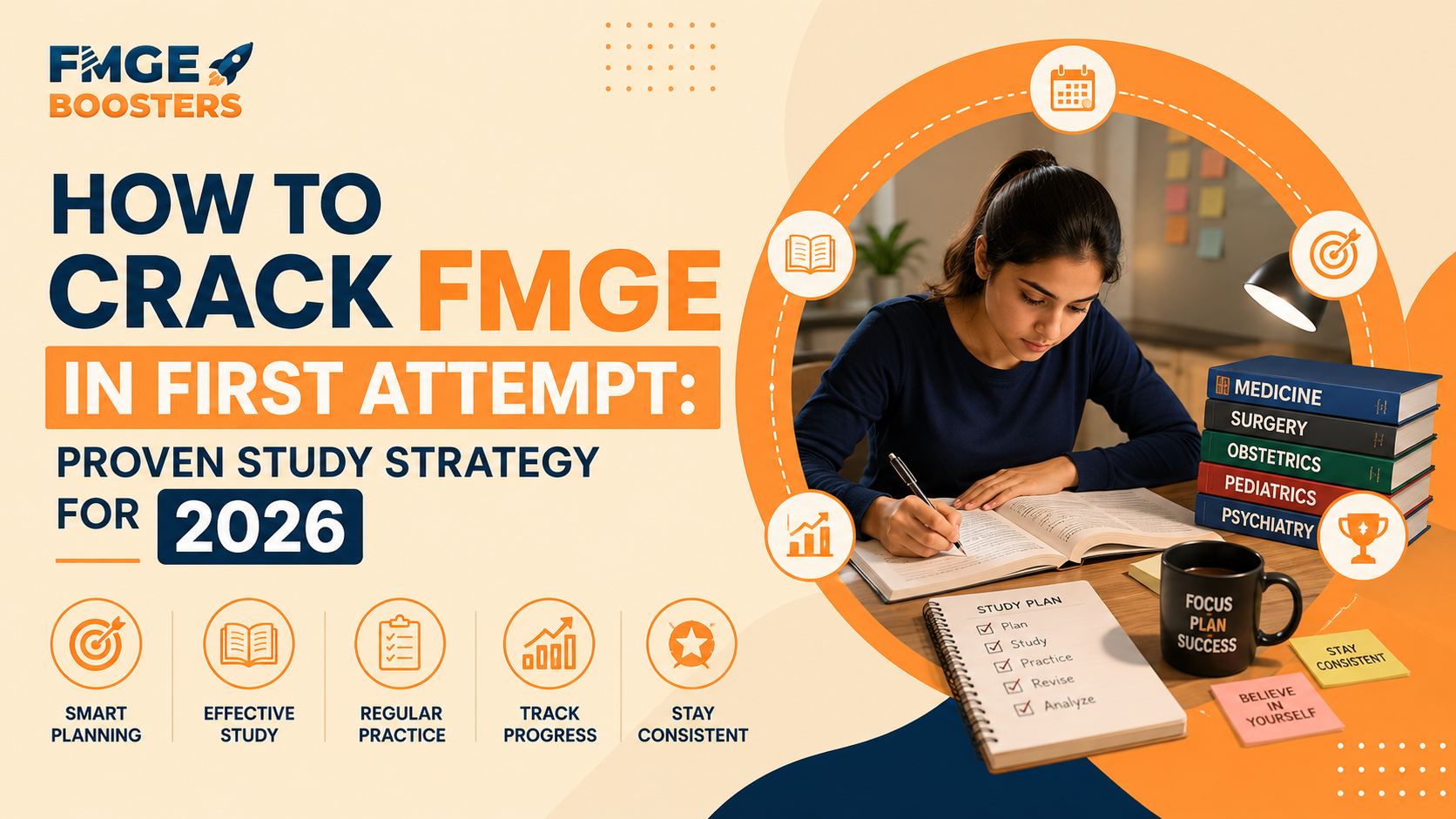
To crack FMGE on your first attempt: understand the exam first, plan around high-weightage subjects, build concepts before memorising, practise MCQs from day one, revise in multiple cycles, and track progress with mocks and previous-year papers. It is not about studying 15 hours a day; it is about studying the right things consistently.
Cracking FMGE on your first attempt is not about studying 15 hours a day. It is about studying the right subjects, revising consistently, solving enough MCQs, and understanding how the exam actually works. In this guide, we break down exactly how successful first-attempt candidates prepare, so you can build a plan that gives you the best chance of clearing FMGE in 2026.
Understand the FMGE before you start preparing
Every aspirant dreams of clearing the exam on their first attempt. While dedicated preparation is essential, understanding the exam before you begin studying is just as important. Knowing what FMGE tests and how it has evolved over recent sessions helps you prepare more effectively.
FMGE is a computer-based licensing examination conducted by the National Board of Examinations in Medical Sciences (NBEMS) for eligible Indian citizens and Overseas Citizens of India (OCI) who completed their primary medical qualification abroad. To qualify, candidates must score at least 150 out of 300 marks. Since there is no negative marking, attempting every question is always recommended. If you are new to the exam or need a detailed understanding of its structure, read our guide on What Is FMGE?
Recent sessions have shown the exam becoming more application-oriented. The June 2026 FMGE, for instance, introduced video-based questions, requiring candidates to observe clinical scenarios before answering. Along with image-based questions and integrated clinical concepts, this reflects a gradual shift away from pure memorisation towards testing clinical reasoning and decision-making. That means simply completing the syllabus is not enough: your strategy should focus on understanding concepts, applying knowledge across subjects, and practising questions that mirror the evolving pattern. The earlier you align with these expectations, the better your chances of clearing FMGE in your first attempt.
Build an FMGE study plan around high-weightage subjects
One of the biggest mistakes aspirants make is giving equal importance to every subject. While every subject in the syllabus matters, not all carry the same weightage in the exam. An effective study plan prioritises high-yield subjects without completely neglecting the rest.
Clinical subjects such as Medicine, Surgery, Obstetrics & Gynaecology, Community Medicine, and Paediatrics consistently contribute a significant number of questions. At the same time, subjects like Anatomy, Physiology, Pharmacology, Pathology, and Microbiology form the foundation for answering many integrated and clinically oriented questions. A balanced strategy should strengthen both conceptual understanding and clinical application.
Before creating your timetable, familiarise yourself with the complete syllabus and identify the subjects that need more attention based on their weightage and your current level. If you have not already, check out our detailed guide on the FMGE Syllabus to understand the subject-wise distribution and important topics.
Instead of trying to complete one subject at a time without revision, divide your preparation into manageable study blocks. Dedicate specific hours to learning new topics, solving MCQs, and revising previously covered subjects each day. This improves retention and prevents the common problem of forgetting topics studied earlier. Remember, your goal is not to finish the syllabus as quickly as possible. It is to complete it in a way that leaves enough time for multiple revisions, mock tests, and targeted practice before the exam.
Focus on concepts, MCQs, and revision for FMGE success
Clearing FMGE on your first attempt is not about reading the same notes repeatedly. It is about understanding concepts, applying them through practice, and reinforcing them with regular revision. This three-step approach matters even more as the exam continues to test clinical reasoning rather than simple factual recall.
Start by building a strong conceptual foundation for every subject. Instead of memorising isolated facts, focus on understanding disease mechanisms, clinical presentations, investigations, and management. This helps you answer integrated questions that require connecting information from multiple subjects. Once you have covered a topic, start solving MCQs immediately. Do not wait until you have finished the entire syllabus. Practising questions alongside your preparation helps you identify weak areas, improves recall, and familiarises you with how concepts are tested. More importantly, review every incorrect answer to understand why you got it wrong instead of simply noting your score.
Recent sessions have also highlighted application-based learning. The introduction of video-based questions in the June 2026 exam showed that candidates are increasingly expected to interpret clinical scenarios rather than rely solely on memorisation. Including image-based questions, clinical case discussions, and scenario-based MCQs in your preparation can help you adapt.
Equally important is revision. Without it, even well-prepared topics become difficult to recall during the exam. Plan multiple revision cycles throughout your preparation instead of leaving everything for the final few weeks. Short, consistent revision sessions are far more effective than trying to revisit the entire syllabus at the last minute. Finally, make it a habit to solve questions from previous-year FMGE papers. While the exact questions may not be repeated, they offer insight into the difficulty level, commonly tested concepts, and how questions are framed. For a subject-wise collection and analysis, explore our guide on FMGE Previous Year Papers.
Use mock tests and previous-year papers to track your progress
Preparing for FMGE is only one part of the journey. Knowing whether your preparation is moving in the right direction is equally important, and this is where mock tests and previous-year papers become invaluable.
Regular mock tests help you assess your conceptual understanding, identify weak subjects, and improve time management. They also familiarise you with the computer-based format, reducing anxiety on exam day. Instead of treating mocks as a way to measure scores alone, use them as a learning tool. Analyse every test carefully to understand the mistakes you made, whether they were due to gaps in knowledge, poor time management, or simple oversight.
Previous-year papers offer valuable insights into the pattern and commonly tested concepts. While the exact questions may not be repeated, they help you understand the difficulty level and the type of clinical reasoning expected. With FMGE gradually incorporating application-based and video-based questions, reviewing recent papers and recall-based discussions can also help you stay updated with evolving trends. Remember, scoring well in mocks is not the final goal. The objective is to improve consistently, so each mock leaves you with fewer weak areas and greater confidence.
Common mistakes that stop candidates clearing FMGE on the first attempt
Many aspirants put in months of hard work but still fall short of the qualifying score. In most cases, it is not because they lacked dedication but because they followed an ineffective strategy. Avoiding these common mistakes can significantly improve your chances.
Studying without a structured plan
Jumping from one subject to another without a clear schedule leads to incomplete preparation and inadequate revision. A realistic timetable with dedicated slots for learning, MCQ practice, and revision keeps you consistent throughout.
Relying on passive learning
Simply reading textbooks or watching lectures is not enough. FMGE increasingly tests your ability to apply concepts in clinical scenarios. Make active learning a habit by solving MCQs, reviewing explanations, and revisiting topics where you make mistakes.
Ignoring revision until the last few weeks
Many candidates spend months completing the syllabus but leave little time for revision. Without multiple cycles, it is easy to forget what you studied. Revising regularly throughout is far more effective than cramming at the end.
Skipping mock tests
Some aspirants avoid mocks until they feel fully prepared. In reality, mocks are an essential part of learning: they reveal weak areas, improve time management, and build confidence before the exam.
Failing to adapt to recent exam trends
FMGE is evolving toward clinical reasoning and application. The video-based questions in recent sessions reinforce the need to prepare beyond rote memorisation. Add clinical case discussions, image-based questions, and scenario-based MCQs to stay aligned with the current pattern.
The key to cracking FMGE in your first attempt is not avoiding difficult subjects or studying longer hours. It is recognising these mistakes early and making small but consistent improvements to your strategy.
Can you really crack the FMGE on your first attempt?
The short answer is yes, but it requires more than hard work alone. Every session sees thousands of candidates clear the exam on their first attempt. What often sets them apart is not the number of hours they study but the consistency and strategy they follow: they understand the pattern, focus on high-yield topics, practise MCQs regularly, revise multiple times, and continuously assess their progress through mocks.
It is also important to remember that every aspirant has a different starting point. Some need more time to strengthen concepts, while others need to improve test-taking skills. Instead of comparing your preparation with others, concentrate on building a plan that works for you and stick to it. With FMGE continuing to evolve through application-based and clinically oriented questions, preparing strategically matters more than ever. If you stay consistent, adapt to recent trends, and focus on understanding concepts rather than memorising facts, clearing FMGE on your first attempt is a realistic and achievable goal.
Conclusion
Cracking FMGE on your first attempt is not about finding a shortcut or studying for endless hours. It comes down to understanding the exam, building a structured study plan, strengthening your concepts, practising MCQs consistently, revising regularly, and learning from mocks and previous-year papers. As the exam evolves with more application-based and clinically oriented questions, your strategy should evolve too. Whether you are just starting or fine-tuning your revision plan, consistency and smart planning make all the difference.
Looking for structured guidance, expert mentorship, and exam-oriented resources? FMGE Boosters supports your preparation with comprehensive study material, mock tests, and strategic learning tools designed to help aspirants prepare more effectively.
Explore FMGE Boosters