
Most FMGE aspirants spend a lot of time studying, but not enough time practising MCQs the right way. You can solve 100 questions a day, check your score, and still walk into the exam unprepared if you never stop to understand why you got certain questions wrong.
How to improve accuracy, in short
To solve FMGE MCQs accurately: keep a mistake notebook and revise it, track your recurring error patterns, time every set (45 to 60 seconds per question), use elimination actively, stick to one resource per subject, and practise your weakest subjects first. With no negative marking, always attempt every question.
This guide is about how to solve FMGE MCQs accurately, not just quickly. Because in an exam where you need 150 out of 300 to pass, accuracy is what keeps you on the right side of that line.
What FMGE's structure means for your MCQ strategy
A quick reminder of the exam structure, because it directly shapes how you should practise. FMGE has 300 MCQs split into two parts of 150 questions each. Each part runs for 150 minutes and is divided into time-bound sections. Once a section closes, you cannot go back. There is no negative marking, which means you should attempt every single question, even when you are unsure.
What this means for your practice
- Never leave a question blank, even in practice. Guess when needed. Always attempting trains you to use your knowledge under pressure rather than freezing.
- Practise in full timed sets as you get closer to the exam, not just topic-by-topic chunks.
- Simulate the two-part structure in your mocks so the mental transition between Part I and Part II after the break does not throw you off on exam day.
Before building your MCQ strategy, review the latest exam pattern and Information Bulletin published by NBEMS FMGE to understand the structure, timing, and marking scheme.
Why FMGE MCQ practice goes wrong for most students
Before getting into what works, it is worth understanding what goes wrong. The most common pattern looks like this: a student does a set of MCQs, checks the answers, marks the ones they got wrong, and moves on. They repeat this every day. And when they get a similar question two weeks later, they get it wrong again.
The problem is not effort. The problem is that they never actually processed the mistake. They saw the correct answer, maybe felt a flash of recognition, and moved on without the kind of deliberate review that actually changes what you remember next time.
FMGE has 300 questions across a broad range of subjects, from Anatomy and Physiology to Surgery, Obstetrics, and Community Medicine. The exam does not reward students who have seen the most questions. It rewards students who have understood the logic behind the right answers. That shift in approach is what this blog is about.
Start a mistake notebook and actually use it
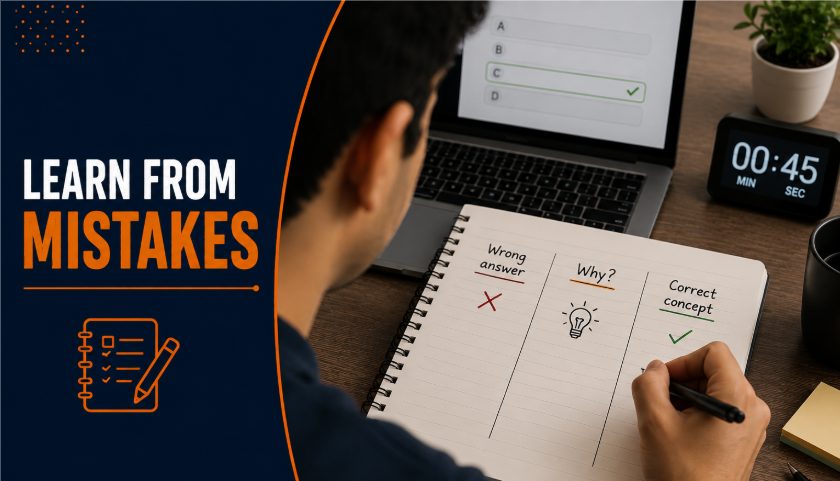
This is one of the most useful habits you can build for FMGE MCQ preparation, and it is also the most consistently ignored one. Every time you get an MCQ wrong, do not just note the correct answer. Write down the following.
- The question stem, or at least the core concept it was testing.
- Why you chose the wrong option.
- The correct answer, with a one or two line explanation of why it is correct.
- The specific concept or fact that you missed.
This takes about two minutes per question. Over weeks, you build a personalised revision document made up entirely of your own gaps. That notebook is worth more than any textbook chapter because it is tailored exactly to what your brain is getting wrong.
The revision part is equally important. Do not just write in it and forget it exists. Set aside time every three to four days to go through your mistake notebook entries. Read them actively, not passively. Cover the answer and see if you can now recall why the correct option is right. If you cannot, that concept needs another round of targeted revision. This process sounds simple, and most students do not do it. Over time, it makes it easier to spot recurring mistakes and improve your accuracy.
If you are finding the same mistakes repeating despite regular practice, structured mentor feedback can help identify recurring weak areas. Many students use the guided review resources available through FMGE Boosters.
Track your patterns, not just your scores
After you have been doing MCQs for a few weeks, start paying attention to something beyond your percentage. Start asking: where do I keep going wrong? Most students have patterns in their mistakes that they never consciously notice. It might be that you consistently misidentify drug mechanisms in Pharmacology, or get confused between similar-sounding organisms in Microbiology, or that Community Medicine statistics trip you up every single time.
These patterns are telling you something important. They are showing you where your conceptual foundation is shaky, not just where you got unlucky on a question. Once you identify a repeating mistake area, do not just do more MCQs from that topic. Go back to the concept. Read that section of your resource again with fresh eyes. Then return to the MCQs. You will find that the same type of question suddenly becomes much more manageable.
Tracking patterns also prevents you from wasting revision time. Instead of giving equal time to everything, you can direct energy toward the areas that are actually costing you marks. This is how you improve accuracy efficiently rather than just practising for more hours. For a broader look at the traps students fall into during FMGE preparation, our post on common mistakes FMGE aspirants make breaks down the bigger picture beyond just MCQ practice.
Time yourself every single time you practise
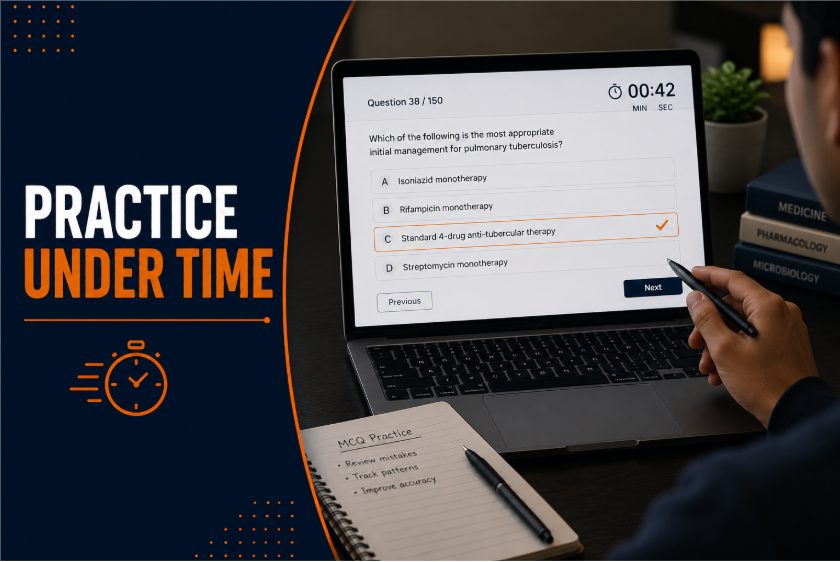
Do not practise MCQs in a relaxed, open-ended way where you stop to think for as long as you like. That is not what the actual exam feels like. FMGE gives you 150 minutes for 150 questions in each part. That works out to exactly one minute per question. And within each part, the paper is divided into time-bound sections, which means you cannot go back once a section ends. If you spend three minutes on a difficult question early in a section, you are giving up time from questions you might have answered correctly later.
Timing yourself during practice is not just about speed. It is about building the mental rhythm of reading a question, processing it, choosing an answer, and moving on without second-guessing yourself excessively. That rhythm is a skill, and it takes deliberate practice to develop. Since FMGE is conducted as a computer-based examination with time-bound sections, it is worth reviewing the latest official instructions before planning your mock sessions. You can find them on the NBEMS FMGE examination page.
Use a timer for every practice set. Aim for 45 to 60 seconds per question when practising. Push yourself slightly beyond your comfort level so that the actual exam feels more manageable, not less. For a deeper breakdown of how to pace yourself across 300 questions and what the top scorers do differently, read our guide on FMGE time management strategy.
Use elimination, not just recognition
One of the most underused skills in MCQ solving is elimination. Most students look at a question and try to identify the correct answer immediately. But when you are unsure, that approach leaves you guessing randomly. Elimination changes that.
Start by reading the question carefully and identifying what it is actually asking. Then look at the four options and ask: which of these can I confidently rule out? Even if you can only eliminate one or two options, you have significantly improved your odds of getting the right answer.
Elimination also helps you catch traps. FMGE MCQs often include distractors that sound plausible but have a subtle error: a drug used for the wrong indication, a statistic that is close but not quite right, a description that fits the wrong organism. If you are actively reading each option critically rather than just scanning for the one that looks right, you are far less likely to fall for those traps.
Practise this deliberately. When you review MCQs after a session, go back to the questions you got right and ask yourself: did I get this right because I genuinely knew the answer, or did I guess correctly? If it was a guess, treat it the same as a wrong answer and add the underlying concept to your revision list.
Stick to your resources. Stop switching.
Here is something that causes real damage to FMGE preparation and is rarely talked about directly. Many students use too many books and resources simultaneously. They are in the middle of one book for Pathology, then they hear about another one and switch. They do MCQs from three different question banks at the same time. They watch videos from multiple platforms on the same subject. The result is a scattered, incomplete understanding of everything rather than a solid understanding of anything.
Pick the resources that work for you and commit to them. This means one primary resource per subject, one question bank for your MCQ practice, and a system of revision built around those same resources. When you encounter a concept in an MCQ that your primary resource covered, you can go back and find it immediately. Your notes, your understanding, and your practice are all aligned.
Switching resources mid-preparation does not fill gaps. It creates new ones. If you are still sorting out which resources to use, the key principle is simple: choose what is readable and clinically oriented, and stick with it. Quality of engagement beats quantity of material every single time.
Cover your weak areas first, not last
Most students follow their comfort zone when practising MCQs. They default to subjects they already do well in because it feels productive and validating to get a high score in a practice session. But if you consistently score well in Anatomy and keep avoiding Forensic Medicine, you are not improving your overall accuracy. You are just confirming what you already know.
The subjects where you are weakest are also the ones where you have the most marks to gain. Covering your weak areas is mathematically the most efficient way to improve your total score. Use your mistake notebook and your pattern tracking to identify these areas clearly. Then deliberately front-load your MCQ practice sessions with those subjects. Yes, your practice scores will drop initially. That is fine. The goal is not to feel good about practice scores. The goal is to pass the FMGE.
This approach, combined with consistent tracking of your mistakes and targeted revision, is the most reliable way to close the gap between where you are and where you need to be.
Conclusion
Solving FMGE MCQs accurately comes down to a few habits done consistently: keeping a mistake notebook and revising it regularly, tracking which areas keep tripping you up, timing every practice session, using elimination as an active skill, sticking to a fixed set of reliable resources, and deliberately targeting your weak subjects.
None of this is complicated. But all of it requires intention. The students who pass FMGE are not necessarily the ones who studied the most. They are the ones who practised the most deliberately and learned something from every question they got wrong. Start with your next practice set. Use a timer. Write down every mistake. Come back to it in three days.
Want to see what deliberate MCQ practice actually feels like before your exam? Try our free MCQ practice test and find out which areas need your attention most.
Try the free MCQ practice test