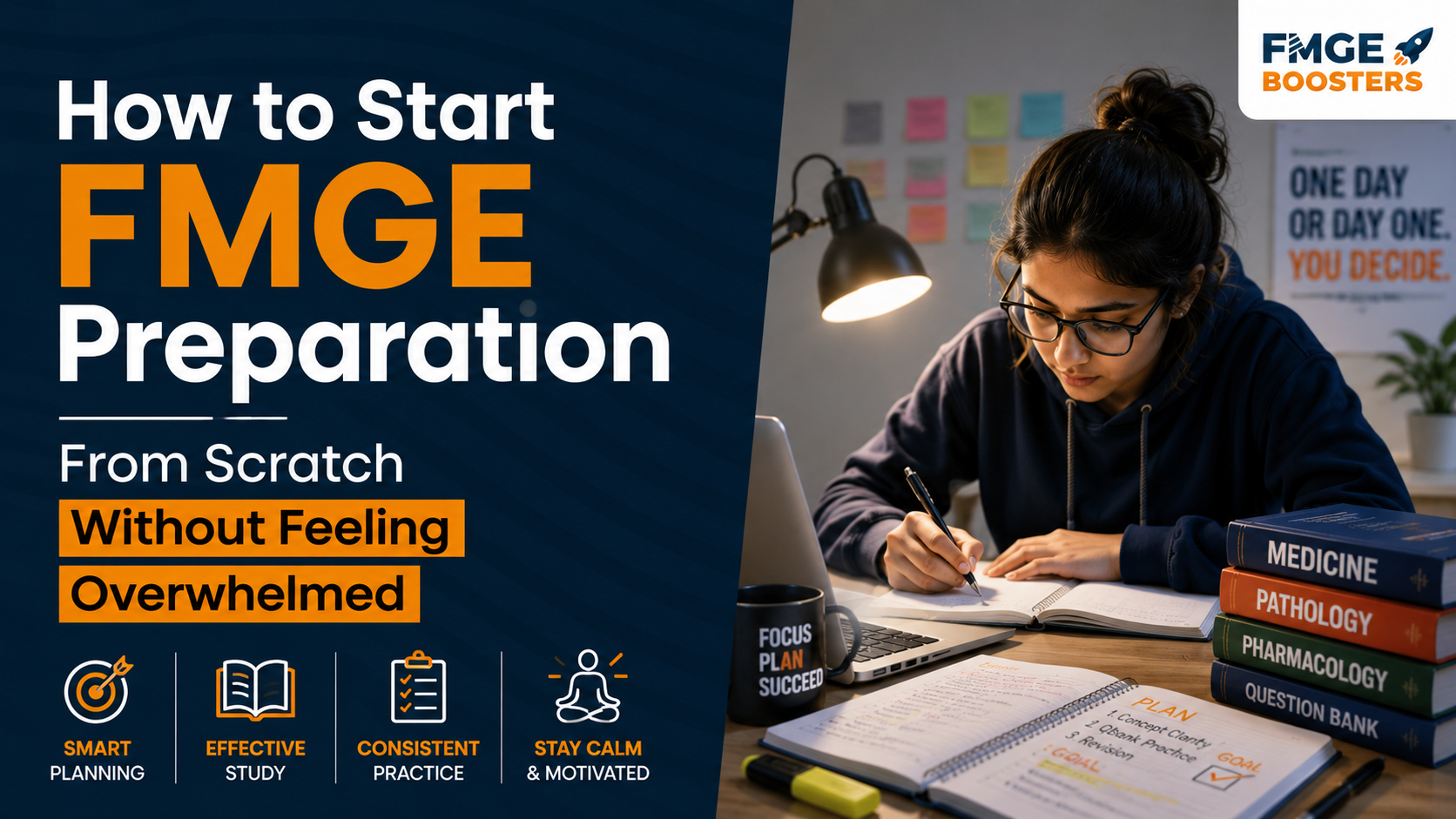
Just decided to begin and already feel a knot in your stomach? Take a breath. Almost every foreign medical graduate freezes the first time they open the FMGE syllabus. The fix is not studying harder than everyone else. It is starting in the right order, with a plan you can actually follow.
How to start, in short
To start FMGE preparation without burning out: understand the exam first (300 MCQs, 150 to pass, no negative marking), break the syllabus down by mark weightage, build a realistic daily plan, pick one book per subject, and study in short, tracked blocks rather than marathons.
Maybe you graduated a few years ago and the textbooks feel unfamiliar, or you are juggling classes or an internship abroad while figuring out where an Indian licensing exam even fits. Either way, this guide walks through exactly what to do: understanding the exam, breaking the syllabus into pieces you can manage, picking books without drowning in options, and building a routine that does not burn you out in week two.
Why FMGE feels so overwhelming when you're just starting out
Most students do not struggle with FMGE because they are not smart enough. They struggle because nobody told them where to begin. You studied medicine in a different country, on a curriculum that does not map neatly onto what FMGE expects, often with a time gap since college and a job or internship eating into your day.
Then there is the comparison trap. You scroll a WhatsApp group, see someone claim they finished Anatomy in ten days, and feel behind before you have even opened the book. Everyone's starting point is different, and most of those loud claims do not tell the whole story. FMGE also rewards quick recognition of the right option rather than long descriptive answers, which can feel unfamiliar if your medical school leaned on theory papers and vivas.
The overwhelm usually comes from trying to hold the entire exam in your head at once. The fix is simpler than it sounds: stop looking at the whole mountain and start looking at the first step.
Get to know the exam before you open a single book
Before deciding what to study, spend a day understanding what you are preparing for. This one step saves weeks of directionless effort later.
FMGE is conducted by the National Board of Examinations in Medical Sciences (NBEMS) twice a year. It is one paper of 300 multiple-choice questions, split into two parts of 150 each, taken on the same day with a break in between. There is no negative marking, so a guess never costs you anything, and you need 150 out of 300 to pass. There is no cap on attempts, but once you qualify you cannot sit FMGE again, so it is worth preparing properly rather than treating an early attempt as a trial run.
The syllabus follows the NMC Competency-Based Undergraduate Curriculum, and the paper has a fixed blueprint. Here is how the marks fall.
| Group | Subjects | Marks |
|---|---|---|
| Pre & para-clinical | Anatomy, Physiology, Biochemistry (17 each) | 51 |
| Pathology, Microbiology, Pharmacology (13 each) | 39 | |
| Forensic Medicine | 10 | |
| Clinical | Medicine and allied | 48 |
| Surgery and allied | 47 | |
| Obstetrics & Gynaecology | 30 | |
| Community Medicine | 30 | |
| Paediatrics, Ophthalmology, ENT (15 each) | 45 | |
| Total | Pre-clinical 100 + Clinical 200 | 300 |
Once these numbers are in front of you, the syllabus stops feeling like a vague mountain and starts looking like a list with a clear order of priority. For the full picture of what the exam covers and who is eligible, see our complete beginner's guide to FMGE, and confirm the latest pattern on the official NBEMS website.
Your 5-step plan to start FMGE preparation
-
Shift your mindset before you touch a book
FMGE is closer to a long walk than a sprint. Give yourself permission to start small; a short, consistent daily session beats one heroic twelve-hour sitting that leaves you exhausted for days. Keep your reason close: you are doing this to practise medicine in India, not to impress a group chat.
-
Break the syllabus into small, manageable pieces
Turn the blueprint into a to-do list. Start with the high-weightage subjects (Medicine, Surgery, OBG, Community Medicine), then Anatomy, Physiology and Biochemistry. Inside each subject, pick the high-yield topics first instead of reading cover to cover. Do not push Community Medicine to the end; it carries 30 marks, the same as OBG.
-
Build a study plan you can actually follow
A syllabus tells you what to study; a plan tells you when. Block realistic hours around your real routine, whether that is a job, internship or family. Two focused hours every day beats ten hours once a week. If you want a ready structure, our FMGE study plan for 3 months, 6 months and 1 year breaks it down session by session.
-
Pick your books without drowning in options
You do not need five books for Pharmacology. You need one or two you actually finish and revise more than once. Pick a standard book per subject that past qualifiers used, stick with it, and add a question bank once concepts feel steady. Unsure where to start? See our guide on the best books for FMGE preparation.
-
Study in small wins, not marathon sessions
Work in 45 to 60 minute blocks with short breaks. After each, ask what you actually learned; if you cannot answer in a sentence, that topic needs another pass. Keep a simple tracker and tick off topics as you go. Also avoid early traps like jumping into mocks before the basics are solid, covered in our common FMGE mistakes and how to avoid them.
How to handle the emotional overwhelm along the way
Some days will feel heavier than others, and that is normal for anyone preparing for a high-stakes exam, not a sign you are doing something wrong.
- Talk to other aspirants instead of isolating yourself with the syllabus. A quick chat with someone who gets it often helps more than another hour of solo reading.
- Be careful with comparison. Someone else's pace, books or study hours are not a measuring stick for your progress.
- Protect sleep, meals and short breaks. Skipping these does not buy productive hours; it just makes the hours you study less effective.
If the overwhelm ever starts to feel like more than ordinary exam stress, it is worth talking to a counsellor or someone you trust rather than pushing through alone.
Starting FMGE preparation from scratch does not have to feel like staring at an unclimbable mountain. Understand the pattern first, break the syllabus down by weightage, build a plan that fits your real life, choose your books carefully, and study in small, trackable wins instead of exhausting marathons.
You do not have to figure all of this out alone. Download our free Beginner's Roadmap for a printable, week-by-week starting structure you can follow from day one.
Download the free Beginner's Roadmap