You have a job. You have patients to see. Your working hours may not always be predictable, and by the time you get home, studying for another four or five hours can feel impossible. Or maybe you started later than you planned, and now the syllabus looks much bigger than the time you have left. In both cases, the answer is not another perfect timetable. You need a study plan that fits the time you actually have.
The short version
Build your plan around your work week, not a full-time student's timetable. Use busy clinical days for focused revision and MCQs, and lighter days or your weekly off for larger topics, PYQs and mocks. Pair MCQs with revision from day one, keep a concise mistake notebook, let PYQs and errors decide what to revise next, and shift toward recall and mock analysis as your time shrinks. Consistency you can sustain beats an ambitious plan that breaks down.
If you are working while preparing for FMGE, or you have started later than you wanted to, here is how to make your preparation more focused without making it more overwhelming. That means knowing what to prioritise, using MCQs and previous-year questions properly, keeping your mistakes organised, and making sure your work schedule does not completely take over your preparation.
Build your FMGE study plan around your work schedule
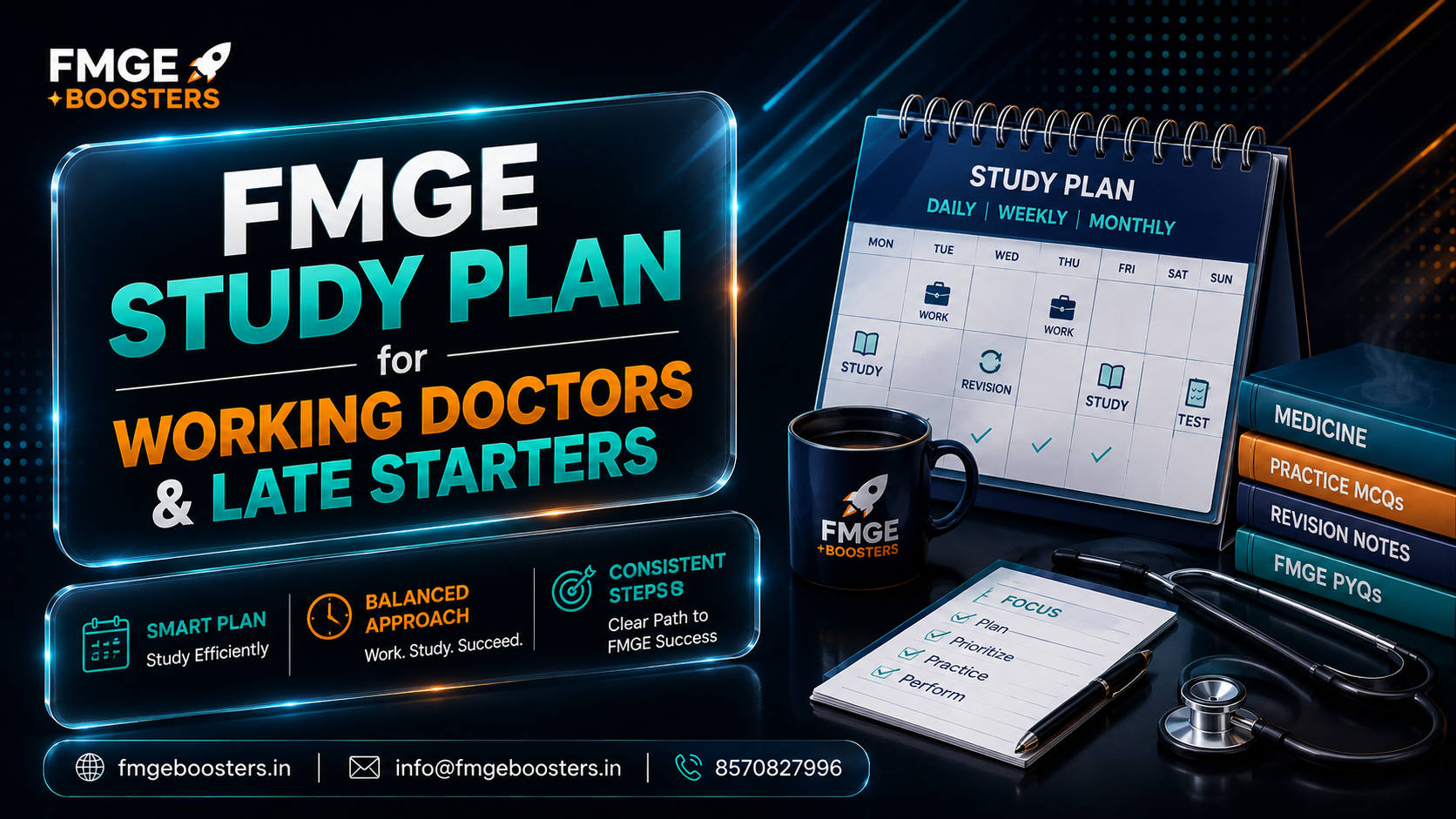
The first mistake working doctors often make is trying to follow a full-time student's timetable. A schedule that expects eight hours of studying every day may look productive on paper, but it may not survive a full clinical day. You follow it for two days, miss it on the third, and then spend the next few days trying to catch up. Instead, look at your actual working week before deciding what your study schedule should look like.
Focused revision and MCQs
Keep demanding days for revision and question practice rather than starting a completely new subject. Short, focused sessions still move your preparation forward.
Larger topics and more questions
On lighter days, take up a bigger topic or spend more time solving questions while you have the energy for deeper concentration.
Your longer study block
Use your off day for PYQs, mixed MCQs, a difficult subject, or a full mock test under exam-like conditions.
The important part is to give yourself some flexibility. You do not have to study for the same number of hours every day; what matters is that your preparation continues throughout the week. If one workday leaves you exhausted, do not try to compensate by adding six extra hours to the next day. Get back to your normal plan and keep moving. Your study plan should support your preparation, not become another source of stress.
Understand the FMGE paper before you decide what to study
When you are short on time, you cannot afford to study without understanding the examination you are preparing for. The FMGE June 2026 blueprint divided the 300 marks between the pre-clinical and para-clinical subjects and the clinical subjects, with 100 marks from the pre-clinical and para-clinical section and 200 marks from the clinical subjects. Medicine carries 33 marks, General Surgery 32 marks, while Obstetrics and Gynaecology and Community Medicine carry 30 marks each.
That does not mean you should ignore the smaller subjects. It means your limited study time should not be distributed blindly. If you are starting late, prioritisation becomes even more important: you need enough coverage across the syllabus while giving appropriate attention to the subjects and areas that can contribute substantially to your score. You should also understand the type of questions you are preparing for. The June 2026 examination included video-based clinical questions, so your preparation should not rely only on traditional fact-based recall; you should also practise applying concepts to clinical presentations and question scenarios. If you have not yet gone through what changed in the 2026 examination, our guide on FMGE 2026 changes and the newer question formats can help you understand what to account for. The point is simple: know the paper before you build the plan.
Make MCQs part of your daily preparation
This is one of the biggest changes you can make if you are working or starting late. Do not study a subject for several days and leave all the questions until you have finished the syllabus. Instead, connect your revision and question practice: revise a topic, solve relevant MCQs, analyse your mistakes, and then revise the weak areas again. For example, if you are revising pneumonia, do not stop after reading the clinical features and treatment. Solve questions on the topic while the concepts are still fresh.
When you get a question wrong, do not just look at the correct option and move on. Try to identify what actually caused the mistake, because each type needs a different response.
Match the fix to the mistake
- Knowledge gap. You did not know the concept at all, so this needs revision.
- Confusion between two conditions. Two similar conditions are getting mixed up, so make a short comparison note.
- Careless or rushed error. You knew the topic but misread the question or eliminated the correct answer, so slow down and recognise the pattern.
This is also where a mistake notebook becomes extremely useful, but do not turn it into another textbook. Keep it short: concepts you repeatedly forget, confusing differentials, important values, drug choices, clinical images, or PYQ concepts you keep getting wrong. As your preparation progresses, this notebook should become smaller and more useful, not longer and more intimidating. If you want to improve this part of your preparation, our blog on How to Solve FMGE MCQs Effectively and Improve Accuracy can help you develop a more structured approach.
Use PYQs to find patterns, not just answers
Previous-year questions are especially valuable when you do not have unlimited time, but simply memorising the correct option is not enough. When you solve a PYQ, look at the concept behind it. If a question tests a particular drug, do not stop after remembering the answer; revise its mechanism, indications, adverse effects, and the situations in which another option may be preferred. The same applies to clinical questions: if you see a question on a particular condition, understand the presentation, investigation, diagnosis and management, so you can recognise the same concept when it appears in a different form.
This makes PYQs much more useful than treating them as a list of questions that may or may not repeat. They can also help you decide what to revise next. If you repeatedly get questions from one topic wrong, that topic deserves another look. If you are consistently answering questions from another area correctly, you do not need to spend hours rereading it simply because it is in your timetable. Let your questions guide your revision; this becomes particularly useful when you are starting late, because every study hour needs to have a purpose. You can also use our FMGE 45-Day Rapid Revision Plan when you need to organise your final revision into a more structured schedule.
If you are a working doctor, use your clinical experience
Working while preparing for FMGE is difficult, but your clinical exposure can also become an advantage. You are seeing patients, presentations and treatment decisions in real life, so use those experiences to strengthen the concepts you are revising. If you see a patient with diabetes, pneumonia, hypertension or anaemia during the day, connect that case with the topic when you revise later: think through the presentation, relevant investigations, first-line management and important complications.
You do not need to turn every patient encounter into a study session, as that would only make your workday more exhausting. Instead, use memorable cases as anchors for concepts you are already studying. A patient you saw during the day can make a topic you revise at night easier to remember, because you are no longer looking at it as an isolated fact from a textbook. This is particularly useful for clinical subjects such as Medicine, Surgery and Obstetrics and Gynaecology, where recognising a clinical presentation and knowing what to do next are important parts of question solving. Your clinical work does not have to compete with your FMGE preparation all the time; where it helps, let it become part of your preparation.
What to do if you have started late
Starting late does not mean you should try to study everything at once. In fact, that approach usually creates more panic than progress. Start by choosing one primary resource for each subject and stick to it. If you have multiple sets of notes, lectures and revision sources covering the same material, constantly switching between them will consume time without necessarily improving your preparation. Then build your revision around three things: coverage, questions and mistakes. Cover the important concepts, solve MCQs and PYQs alongside your revision, and use your mistakes to decide what needs another revision. As the examination gets closer, gradually shift more of your time towards active recall, MCQs, PYQs, mock tests and your error log instead of repeatedly reading the same material.
Let your focus shift as your time shrinks
If you have more time before the exam, focus more on concept building, subject coverage and regular MCQs. If your time is limited, put greater emphasis on high-priority topics, MCQs, PYQs and weak areas. If you have very little time left, shift towards rapid revision, recall, PYQs, mistakes and mock analysis. Treat this as a way to understand where your attention should move, not as a rigid timetable.
And if you miss a study session because of work, do not let one missed day turn into a missed week. Start the next day again. Your preparation does not need to look like someone else's to be effective. You need a plan you can actually follow alongside your work.
Make your limited study time count
If you are working while preparing for FMGE, you may not have the luxury of spending the entire day with your books, but that does not mean your preparation has to be unstructured. Plan around your work schedule instead of fighting it. Use lighter days for larger topics and difficult workdays for focused revision and MCQs. Keep PYQs in your preparation from the beginning, maintain a concise mistake notebook, and use your mock-test performance to decide what needs attention next. If you are a working doctor, use your clinical exposure wherever it helps you remember concepts more naturally. And if you have started late, do not spend the remaining time worrying about how much you have not completed. Use the time you still have. A focused study session, followed by well-analysed questions and targeted revision, can be far more useful than hours of unfocused studying. You do not need a perfect preparation schedule. You need one that keeps you moving forward.
For more structured FMGE preparation, revision resources, and exam-focused guidance, explore FMGE Boosters.
Explore FMGE Boosters