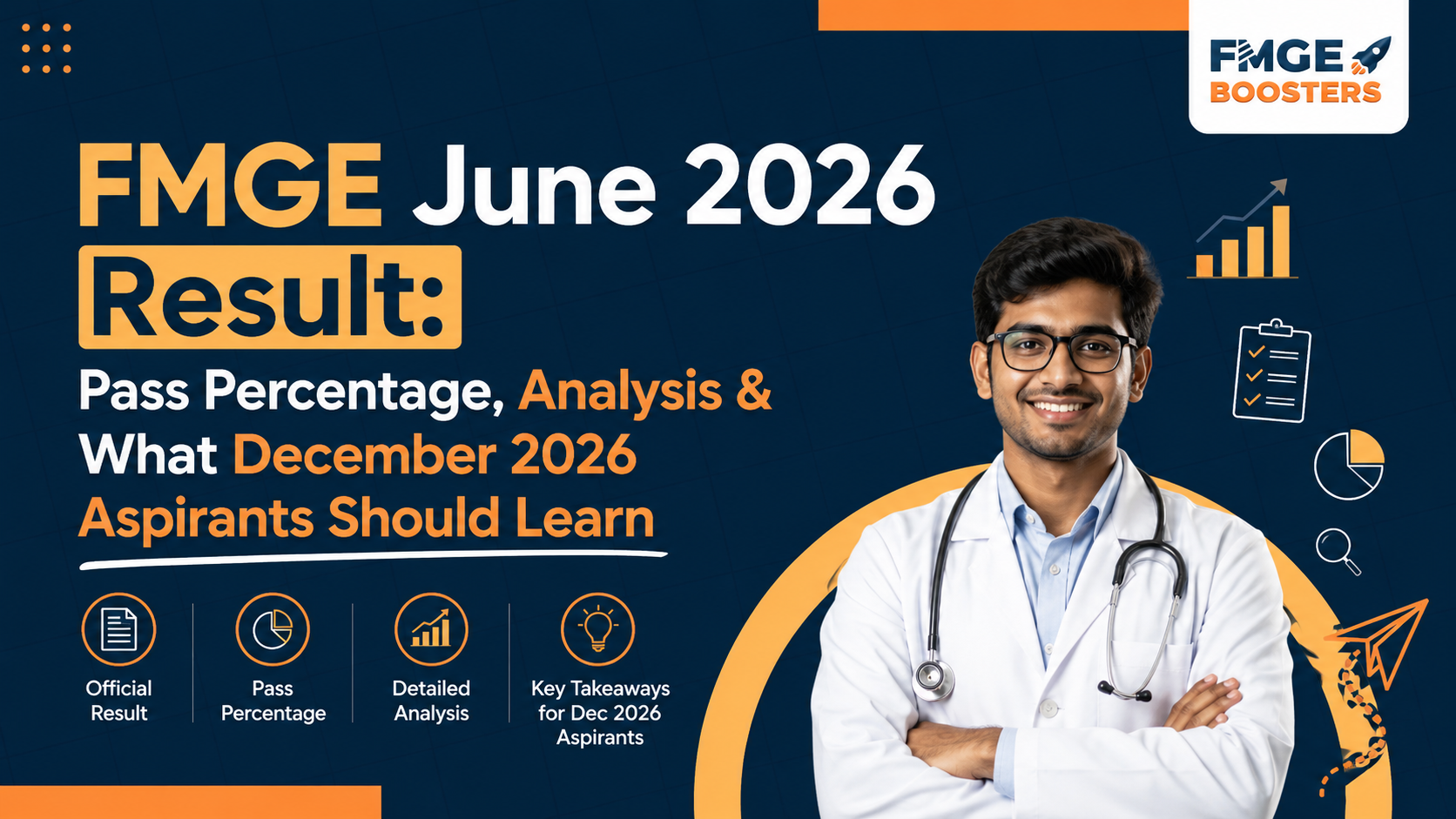
The FMGE June 2026 result is out, and the pass percentage is 12.38%. Out of 37,448 candidates, only 4,635 cleared the exam. That number is not here to scare you if you are preparing for December 2026. But it should make you pause and look at how you are preparing right now.
The result, in short
The FMGE June 2026 pass percentage was 12.38%: 4,635 of 37,448 candidates qualified. FMGE is a qualifying exam, not a ranking one, so anyone scoring 150 of 300 passes. The low pass rate points less to an impossible exam and more to a paper that rewarded clinical application and integrated thinking over direct recall.
The June session was not only about how much students studied. Candidate discussions after the paper pointed towards something bigger: questions that required more clinical application, better integration between subjects, and the ability to think beyond direct recall.
If your preparation still looks like finishing notes, memorising one-liners, and hoping PYQs repeat exactly as they are, this is the time to change that. In this blog, we break down what the June 2026 result tells us, what candidates reported about the paper, and what you need to do differently before the FMGE December 2026.
FMGE June 2026 result: the numbers you need to know
The FMGE June 2026 results listed a total of 37,448 candidates. Out of these, 4,635 candidates qualified.
| Category | Candidates | Percentage |
|---|---|---|
| Passed | 4,635 | 12.38% |
| Failed | 31,645 | 84.50% |
| Absent | 1,148 | 3.07% |
| Withheld | 20 | 0.05% |
| Total candidates | 37,448 | 100% |
A pass percentage of 12.38% is low, but the number alone does not tell you the full story. FMGE is not an exam where you need to score exceptionally high. You need 150 out of 300 to qualify, and there is no negative marking. That means every correct answer matters, every attempted question can add to your score, and you do not need to be perfect across all 19 subjects to clear it.
If you are still getting familiar with how the exam works, including the paper pattern, marking scheme, and subject-wise structure, start with our guide on What Is FMGE?
So when more than 31,000 candidates fall short, the question is not whether FMGE is impossible to pass. The question is whether their preparation was enough for the kind of paper they faced. Studying for months is not the same as being exam-ready. You can finish notes, revise one-liners, solve PYQs, and still struggle if you cannot apply those concepts in a clinical case, eliminate close options, or manage 300 questions under pressure. That is what December 2026 aspirants need to pay attention to now.
What does a 12.38% pass percentage actually tell us?
A 12.38% pass percentage is not a number you should ignore. But it is also not proof that FMGE is impossible to clear. You still need 150 out of 300. There is no rank, no percentile, and no separate cut-off that changes depending on how everyone else performs. If you get the required marks, you qualify.
So the real issue is not that students need to know every single thing from all 19 subjects perfectly. The issue is that FMGE exposes gaps very quickly. You may have studied a topic before, but can you recall it when the question is framed as a clinical case? Can you eliminate two close options instead of getting stuck between them? Can you move on from a difficult question without losing time on the rest of the paper? That is where many attempts fall apart.
Some students spend months completing notes but do not revise enough. Some keep solving questions without analysing why they got them wrong. Others know their weak subjects but keep postponing them because they feel harder to deal with. FMGE does not reward how many resources you finished. It rewards how much you can recall, apply, and manage in those 300 questions. For December 2026, you do not need a perfect preparation plan. You need one that is honest about your weak areas and gives you enough practice to fix them before the exam.
What candidates reported about the June 2026 paper
One thing that came up repeatedly after the June 2026 FMGE was that the paper did not feel limited to direct one-line recall. Candidates spoke about questions where knowing the fact was only the first step. You still had to understand the clinical situation, pick out what the question was actually asking, and apply the concept before choosing an answer.
Some candidates also reported seeing short video-based clinical questions. These required them to watch a clip, notice the relevant findings, and answer an MCQ based on what they observed. This does not mean the FMGE syllabus has changed, and it does not mean every December 2026 aspirant needs to suddenly start preparing from new resources or spend hours watching random clinical videos. But it does tell you something important.
A topic may be familiar when it appears as a one-liner in your notes. The same topic can feel completely different when it is shown through a patient examination, an image, a clinical case, or a short video. That is where many students get stuck: not because they have never studied the topic, but because they have only practised recalling it in one format. For December 2026, do not prepare only to recognise a line from your notes. Prepare to identify the finding, connect it to the concept, and then choose the answer.
If you want to understand what candidates reported seeing and how to prepare for this format without changing your entire strategy, read our guide on Video-Based Questions in FMGE: Lessons from June 2026.
Why video-based questions matter for December 2026 aspirants
The mistake would be to treat video-based questions like a completely separate part of FMGE preparation. They are not. You do not need a separate notebook for them, and you do not need to spend hours watching random clinical clips to convince yourself you are now prepared for video questions. The point is not the video. The point is what the question expects you to do with it.
In a regular MCQ, you may be given fever, cough, breathlessness, and an X-ray finding in writing. In a video-based question, you may have to notice the patient's breathing pattern, gait, posture, facial appearance, movements, or examination findings before you even reach the question. The topic has not changed. It is still from the same syllabus you are already studying. But instead of being handed every clue in a sentence, you have to pick out the clue yourself.
That is why just memorising that a disease has a particular sign is not enough. You should know what that sign looks like, why it happens, and what it points towards clinically. Otherwise, the same topic can feel unfamiliar the moment it appears outside your notes.
So while revising, start asking yourself more than "What is the diagnosis?" Ask yourself what you would notice first if this were a real patient. What finding would help you rule out the wrong options? What investigation or management step would logically come next? That is the habit you need to build for December 2026. Whether the question appears as text, an image, a case, or a short video, you should be able to work your way through it instead of waiting for the answer to look familiar.
The bigger lesson: FMGE is testing application, not just recall
If there is one lesson from the June 2026 paper, it is this: understanding a concept is becoming more important than simply remembering it.
Think about how most students revise. They finish Microbiology, move on to Pathology, then Pharmacology, and finally Medicine. Each subject is revised separately because that is how most notes and lectures are organised. The problem is that the FMGE paper does not think in subjects.
A question on pneumonia is not just testing whether you remember the organism. It may expect you to recognise the clinical presentation, identify the likely pathogen, choose the appropriate investigation, and know the drug of choice, all within a single MCQ. The same applies to many common conditions you revise throughout your preparation. The examiner is not asking how well you remember a chapter. They are asking whether you can apply what you know to this patient.
That is why disease-based revision becomes so important. Instead of treating every subject as a separate checklist, start connecting the concepts. When you revise a disease, think beyond one chapter: ask how the patient presents, what causes the condition, which investigations confirm it, and what the appropriate management would be. This does not mean changing your resources or studying five subjects together. It simply means making connections while you revise.
The June 2026 paper analysis suggests that this kind of integrated thinking is becoming increasingly important. If you want a detailed breakdown of the paper and the key learning points from the session, read our guide on the FMGE June 2026 Paper Analysis.
What December 2026 aspirants should change from today
If you are appearing for FMGE in December 2026, you still have something many June candidates no longer do: time to change your preparation before it becomes a problem. The June 2026 paper does not mean you need new books or a completely different study plan. It means you need to make better use of the resources you are already studying from.
- Use PYQs to learn, not just to score. Keep solving them, but do not stop after finding the correct answer. Ask why the correct option is right, why the others are wrong, and whether the same concept could be tested through a clinical case, an image, or a video.
- Revise for recall, not familiarity. Reading notes repeatedly feels productive because everything looks familiar, but familiarity is not recall. By your final revision, you should be able to explain a topic without looking back at your notes. If you cannot retrieve it on your own, it needs more work.
- Add case-based MCQs. Not because every December question will be case-based, but because they teach you to think through a clinical problem instead of hunting for a keyword. After every session, spend a few minutes analysing your mistakes: unsure of the concept, misread the question, or eliminated the wrong option?
- Practise under exam conditions. FMGE is a 300-question exam, and knowing the answer is only part of it. You also need to hold concentration, manage time, and avoid over-investing in one difficult question. The more you practise under exam-like conditions, the more natural those decisions become on the day.
If time management is something you struggle with, our guide on FMGE Time Management Strategy explains how to pace yourself through all 300 questions without compromising accuracy.
What December 2026 aspirants should take from the June 2026 result
If you are preparing for FMGE December 2026, do not look at the June 2026 result as just another pass percentage. Look at what it tells you about the exam. The discussions after the paper suggest candidates were expected to do more than recall isolated facts. They had to apply concepts, connect subjects, and work through clinical scenarios. Whether the question appeared as a one-liner, an image, a case, or a short video, the expectation remained the same: understand the concept before choosing the answer.
The good news is that you still have time to adapt your preparation. Use the next few months to strengthen your concepts instead of simply finishing the syllabus. Analyse every MCQ instead of only checking whether you got it right. Spend more time revising weak areas, solving case-based questions, and practising under timed conditions. Most importantly, stop changing resources every few weeks. Pick your core resources, revise them thoroughly, and let your MCQ performance guide what needs more attention.
The June 2026 result is not a prediction of what will happen in December. It is simply the latest reminder that FMGE rewards students who understand concepts and know how to apply them under exam pressure. Start making those changes now, and you will give yourself a much better chance of being on the other side of the statistics.
Preparing for FMGE December 2026? Download our FMGE Preparation Guide and build a clearer plan for revision, MCQs, and timed practice.
Download the FMGE Preparation Guide