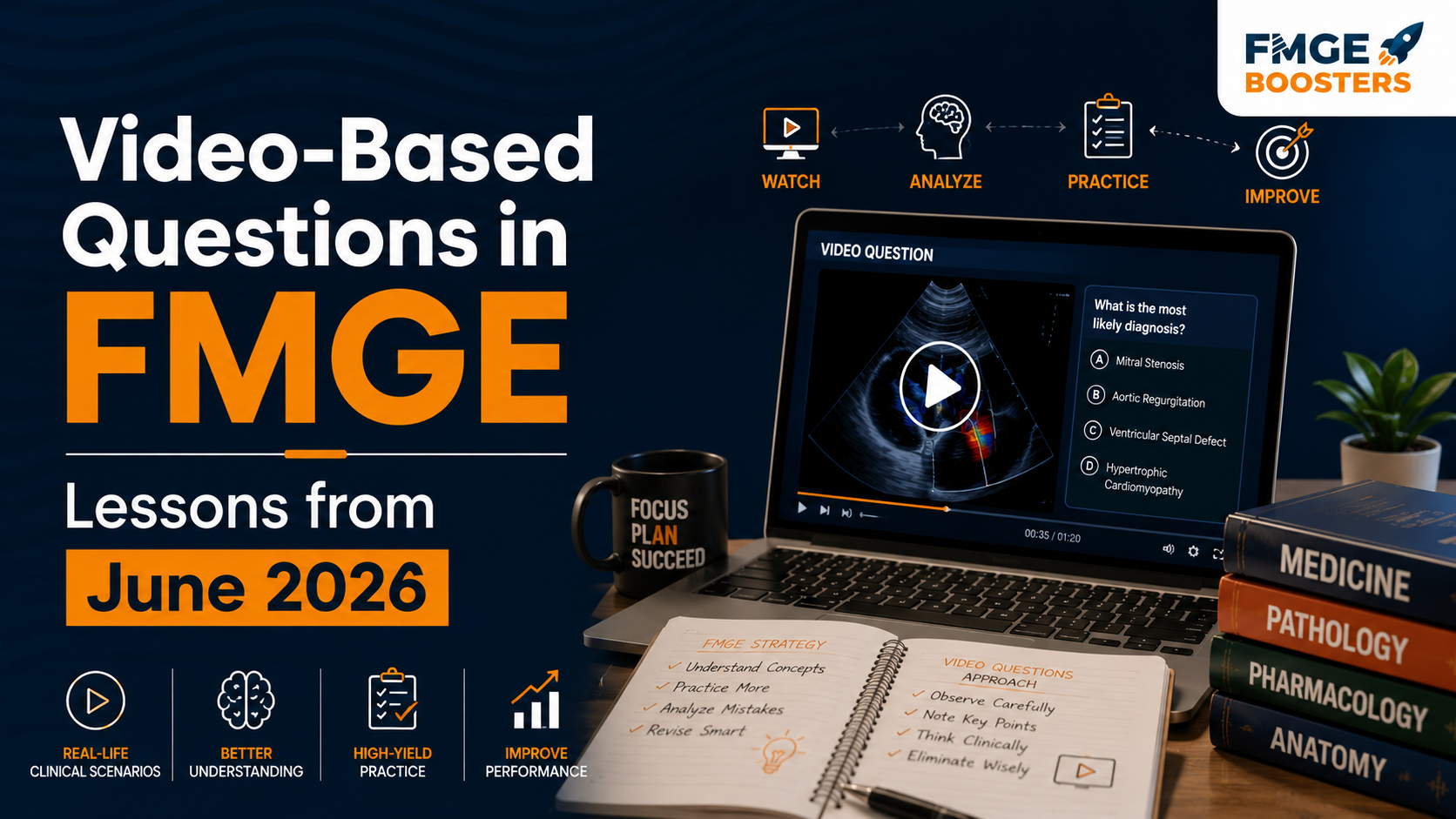
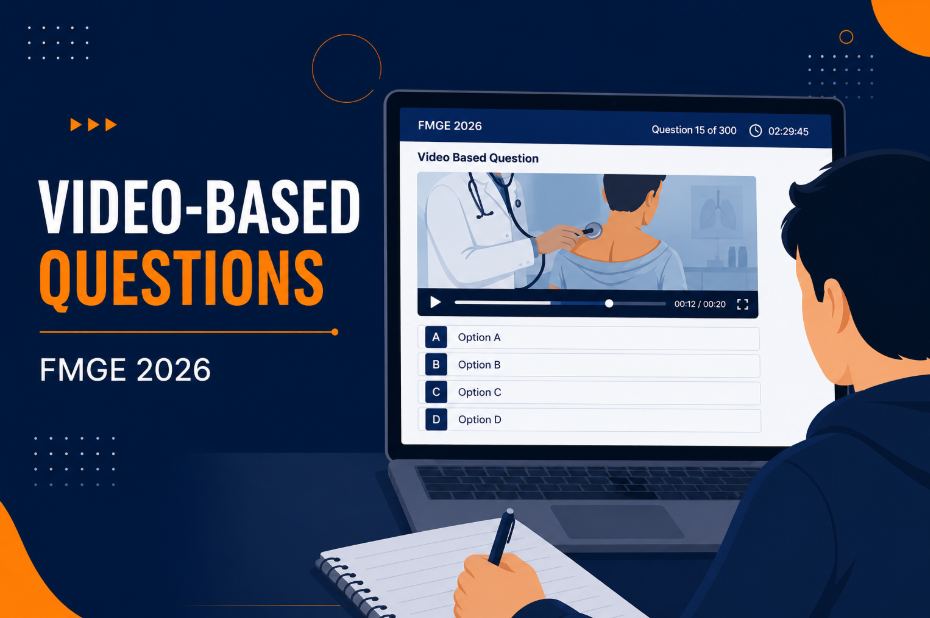
If you spoke to anyone who appeared for the FMGE on 28 June 2026, chances are they mentioned one thing they did not expect: video-based questions.
In short
Some FMGE June 2026 candidates reported video-based questions: short clips of roughly 15 to 20 seconds shown before a multiple-choice question. These questions did not add new syllabus. They tested whether you can observe clinical findings, connect concepts across subjects, and apply your knowledge — the same skills text and image questions assess. The best preparation is to build strong concepts, revise diseases (not isolated subjects), and practise case-based MCQs.
Instead of reading a written clinical scenario or interpreting a single image, some candidates reported watching short video clips before answering a multiple-choice question. For many, the challenge was not the concepts. It was the unfamiliar format. The good news is that these questions do not introduce a new syllabus. They simply test how well you can apply knowledge you have already learned.
In this guide, we look at what candidates reported seeing, why these questions felt different, what they actually test, and how to prepare confidently if similar questions appear in future FMGE sessions.
What were the video-based questions in FMGE?
Based on feedback shared by candidates after the June 2026 FMGE, some questions were presented using short video clips lasting approximately 15 to 20 seconds. Candidates watched the clip first and then answered a multiple-choice question based on what they observed.
Unlike image-based questions, which ask you to identify a finding from a single picture, video-based questions ask you to interpret a sequence of clinical findings before choosing the most appropriate answer. Candidates reported scenarios such as:
- A forensic demonstration showing lungs being placed in water during an autopsy.
- An infant examination where candidates needed to observe posture, movements, facial appearance, and physical findings before answering.
- Clinical examination videos where recognising subtle patient findings mattered more than recalling a memorised fact.
Although the scenarios varied, the approach stayed the same. The examiner was not asking you to recall another isolated fact. The question tested whether you could observe a clinical situation, interpret the findings, and apply your medical knowledge to reach the correct answer.
If you are unfamiliar with how different question formats fit into the overall examination, our guide on the FMGE exam pattern and marking scheme explains the exam structure in detail.
Why did these questions feel different?
For most candidates, the challenge was not the concepts themselves. It was the way those concepts were presented. Most FMGE questions begin with a written clinical scenario, a direct factual question, or a single image. Students become familiar with these formats throughout their preparation.
Video-based questions work differently. Instead of immediately reading the question, candidates first need to watch the clinical scenario, identify the important findings, and only then decide how to approach the answer. That extra step changes how you process the question. Rather than jumping straight to recalling a fact, you first need to understand what you are looking at. For many candidates, that shift felt unfamiliar simply because they had not practised it before.
The important thing to remember is that the concepts being tested have not changed. Only the way they are presented has.
What are video-based questions really testing?
At first glance, it might seem like these questions simply test how quickly you can identify a clinical finding. In reality, they assess whether you can connect different concepts and apply them to a clinical situation. The video may last only 15 to 20 seconds, but answering correctly depends on concepts you have been building throughout your entire MBBS journey.
Imagine you are watching a short clinical video of a patient with jaundice. Recognising the clinical signs is only the first step. You may then need to identify the likely diagnosis, understand the underlying disease process, and answer a question about the most appropriate investigation, management, or even the mechanism of action of the drug of choice.
Similarly, a short clinical video may show a patient with pneumonia and ask you to recognise the clinical signs. Instead of stopping at the diagnosis, the question may go one step further and ask about the mechanism of action of the most appropriate drug. To answer either question confidently, you need to connect concepts from multiple subjects rather than treating each subject separately.
That is exactly how medicine works in real life. Patients do not present with separate Physiology, Pathology, Pharmacology, or Medicine questions. They present with symptoms, and it is your job to connect the dots before reaching the correct diagnosis or management plan.
Questions presented through short clinical videos appear to assess this ability to integrate concepts while solving a clinical problem. If you have been studying each subject independently until now, this is a good reminder to start connecting related topics during revision. Studying diseases as complete clinical cases, instead of isolated subjects, builds that habit while strengthening your overall understanding. Our guide on how to build strong concepts instead of memorising for FMGE explains how conceptual understanding helps you approach integrated clinical questions with greater confidence.
How can you prepare for video-based questions?
The first reaction many students had after hearing about these questions was: "I need to find similar videos and practise them." Watching clinical videos can certainly help, but it should not become your entire strategy. The real takeaway from the June 2026 FMGE is not that you need hundreds of videos. It is that you need to become comfortable applying your knowledge in different formats.
- Watch clinical examination videos with a purpose
Do not watch passively. Pay attention to how the examination is performed, which findings stand out, and how they lead to a diagnosis. Whenever possible, pause the video before the explanation and ask yourself what is happening. Then compare your reasoning with the final diagnosis. This habit develops the exact thought process these questions assess.
- Revise diseases, not just subjects
Instead of revising Medicine, Pharmacology, or Pathology as separate subjects, revise one disease from multiple perspectives. While studying pneumonia, for example, connect the clinical presentation, underlying pathology, relevant investigations, treatment, and mechanism of action of commonly used drugs into one complete clinical picture.
- Make every case-based MCQ a learning opportunity
Do not rush through case-based MCQs just to increase your question count. After solving one, spend a few extra minutes understanding why the correct answer was right and why the other options were wrong. Over time, you begin recognising patterns instead of memorising answers — a skill that helps whether the question is text, an image, or a short clinical video.
Does this mean FMGE is becoming more clinical?
Based on feedback shared by candidates after the June 2026 FMGE, there appears to be a greater emphasis on applying concepts in clinical scenarios. That does not necessarily mean the syllabus has changed or that students need to completely rethink their preparation. Instead, it highlights an important shift in how familiar concepts may be assessed.
Whether a question is presented as text, an image, or a short clinical video, the expectation remains the same: understand the clinical findings, connect the relevant concepts, and choose the most appropriate answer. In many ways, that is exactly what medical education has always aimed to teach. If anything, these questions reinforce the importance of preparing with understanding rather than memorisation.
Students who focus on building strong concepts, revising related subjects together, and practising case-based questions are already developing the skills these questions require. If your current preparation does not include those habits yet, now is a good time to start. Understanding how recent FMGE sessions are evolving can help you prioritise more effectively. Our analysis of FMGE previous-year trends and which subjects are becoming more important explores these patterns in greater detail.
Focus on the skills, not just the format
It is natural to feel surprised when a new question format appears in an exam. But while the format of FMGE questions may continue to evolve, the fundamentals of good preparation stay the same. Build strong concepts, connect related subjects, and focus on applying what you learn instead of simply memorising facts.
If you prepare that way, you will be ready whether the next question comes as text, an image, or a short clinical video. The format may be different, but your ability to understand and apply concepts is what will ultimately help you answer with confidence. Stay consistent, keep refining how you study, and trust the effort you are putting in.