If you are preparing for the FMGE and trying to decide between online and offline coaching, you are not alone. This is one of the most common dilemmas FMGE aspirants face.
The short answer
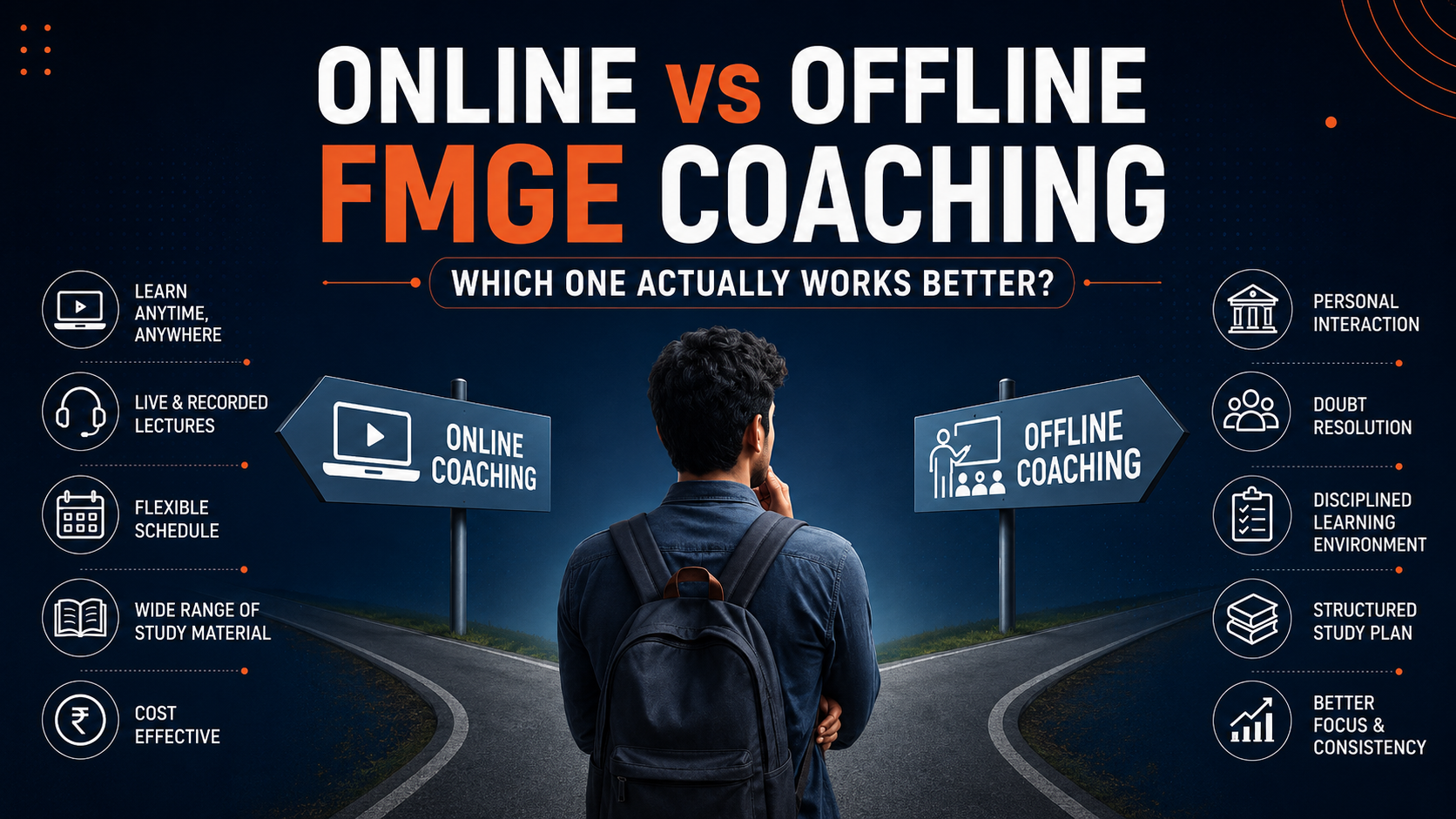
Neither format is universally better — the right choice depends on your learning style, budget, location and how much structure you need. Choose offline if you need external discipline, learn best through live interaction, and can manage the cost of relocating. Choose online if you are self-disciplined, on a tighter budget, or lack a quality institute nearby. Many aspirants now use a hybrid model: online for subject-wise prep, offline test series in the final weeks.
This is especially true for aspirants returning from countries like Russia, Ukraine, China, or Bangladesh, where the studying environment was very different from India. Here is the truth: there is no universally correct answer. But there is a right answer for your situation, and that is exactly what this guide will help you figure out. We compare both options head-on and give you a clear way to decide, with no fluff and no bias.
Why this decision matters more than you think
Most students treat the coaching question as secondary. They think, "I'll just pick something and start." But the wrong coaching format can cost you months of wasted effort and, in some cases, a failed attempt.
FMGE has a historically low pass percentage, often hovering around 15 to 20% in most sessions conducted by the National Board of Examinations in Medical Sciences (NBEMS). With 300 questions across pre-clinical and clinical subjects and a minimum of 150 marks needed to pass, your preparation strategy genuinely matters. Choosing the wrong format does not mean you will fail — but choosing the right one for your lifestyle and learning style can make your preparation significantly more focused and efficient.
Before you decide, make sure you have a clear picture of what FMGE is and who needs to appear for it. If you are new to the exam, our guide on the FMGE exam pattern and marking scheme explains the exam structure, eligibility criteria, and passing requirements in detail.
What FMGE's structure demands from your preparation
It is worth remembering what you are actually preparing for. FMGE is a 300-question computer-based test split into two parts of 150 questions each, with 150 minutes per part and time-bound sections within each part. There is no negative marking, and you need a minimum of 150 out of 300 to pass.
The exam covers 100 marks of pre and para-clinical subjects (Anatomy, Physiology, Biochemistry, Pathology, Microbiology, Pharmacology, and Forensic Medicine) and 200 marks of clinical subjects (Medicine, Surgery, Obstetrics and Gynaecology, Community Medicine, Paediatrics, Ophthalmology, ENT, and others). Given the breadth of the syllabus and the structure of the paper, both your subject knowledge and your test-taking speed matter. Any coaching format you choose must help you build both.
What does offline FMGE coaching actually look like?
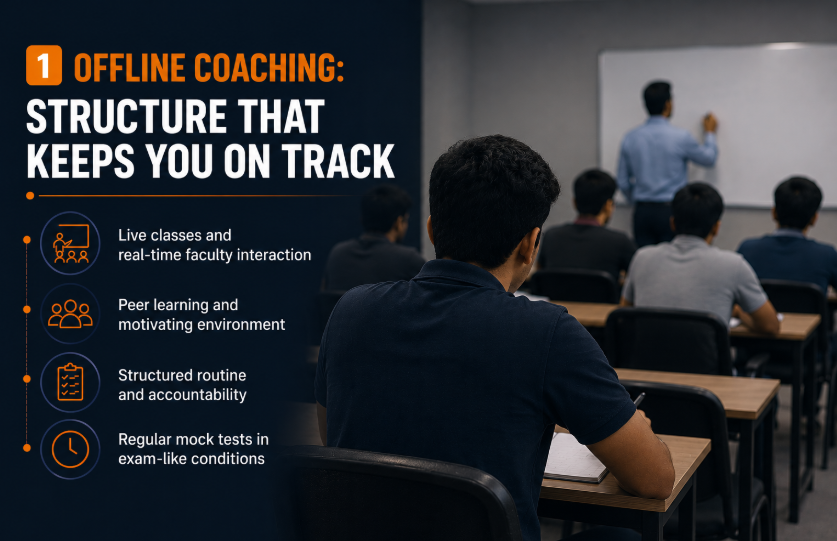
Offline coaching typically means enrolling in a physical institute, usually in cities like Delhi, Kochi, Hyderabad, or Bangalore, attending daily classes, and following a structured classroom routine.
The strengths of offline coaching
- Structured routine and accountability. When you physically go somewhere every day, you are far less likely to skip. That external discipline is something many students genuinely need, especially after five or six years abroad.
- Direct faculty interaction. You can raise doubts on the spot, and a teacher can explain the same concept three different ways until it clicks — invaluable for concept-heavy subjects.
- Peer learning. Being surrounded by other aspirants creates an organic study culture. You pick up what others are revising, form study groups, and often learn faster.
- Mock tests in a simulated setting. Sitting in an exam hall with a timer and other candidates builds comfort with time management and exam pressure.
The limitations of offline coaching
- Location and cost. Relocating or commuting adds cost and stress. Hostel, food, travel and tuition combined can easily run into one to two lakhs or more for a quality institute.
- Fixed pace. The class moves at one speed. Strong in Anatomy already? You still sit through it. Weak in Community Medicine? The class may not slow down for you.
- Limited access after class. Once you walk out, the lecture is gone unless notes were shared — no revisiting that tricky pharmacology mechanism at 11 PM.
What does online FMGE coaching actually look like?
Online coaching has evolved enormously in the last five years. It is no longer just recorded lectures dumped on a drive. Quality platforms now offer structured modules, live classes, doubt-clearing sessions, subject-wise mock tests, and progress tracking.
The strengths of online coaching
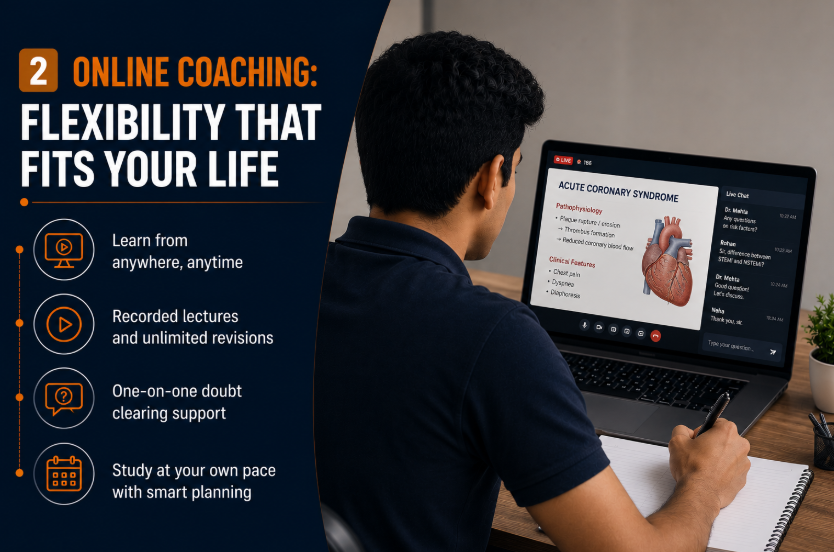
- Study from anywhere, anytime. Whether you are in Lucknow or Lagos, you get the same content — a game changer for students still abroad or in smaller towns.
- Repeat lectures as many times as needed. Pause, rewind and replay a difficult concept until it makes sense, without racing the clock or the teacher's pace.
- Cost efficiency. A well-structured online course is almost always more affordable once you factor in living costs, freeing budget for test series or reference resources.
- Self-paced flexibility. Skip ahead where you are strong, and spend three hours on Microbiology one day based on what your recent mock revealed.
- Access to a wider pool of faculty. Platforms bring together subject specialists from different cities, not just whoever teaches at the local institute.
The limitations of online coaching
- Self-discipline is non-negotiable. The freedom that makes online great also makes it risky. Without a fixed schedule, many students drift and "study" without retaining anything.
- Internet and device dependency. Unreliable internet, device problems or power cuts can disrupt preparation at critical moments.
- Isolation can creep in. Studying alone for hours without the energy of a classroom can feel draining and make motivation harder to sustain.
- Doubt resolution can be slower. Even with doubt sessions, you may wait hours or a day for an answer that a classroom would resolve immediately.
Online vs offline FMGE coaching: a direct comparison
| Factor | Online coaching | Offline coaching |
|---|---|---|
| Cost | Lower overall | Higher (includes living costs) |
| Flexibility | High | Low |
| Accountability | Requires self-discipline | Built into the structure |
| Faculty interaction | Scheduled sessions | Immediate in class |
| Location | Anywhere | Fixed city |
| Lecture access | Anytime (recorded) | During class only |
| Peer environment | Limited | Strong |
| Mock test quality | Varies by platform | Often simulated well |
So, which one should you choose?
By this point, you have probably realised that neither format is objectively better. The right choice depends on how you learn best and what kind of preparation environment helps you stay consistent.
Go with offline coaching if:
- You struggle with self-discipline and need external structure.
- You learn best through live interaction and group energy.
- You can manage the cost and relocation without significant stress.
- You are a first-time aspirant without a clear sense of your weak areas yet.
Go with online coaching if:
- You are disciplined and have already built a consistent study habit.
- You are based somewhere without quality offline FMGE institutes nearby.
- You are on a tighter budget but still want structured preparation.
- You are a repeat aspirant who knows your weak spots and needs targeted content.
- You have family or personal commitments that make fixed classroom hours impractical.
Consider a hybrid approach if:
Many students now do this successfully. They use online coaching for the bulk of their subject-wise preparation and join an offline test series or crash course in the final weeks. You get the flexibility of online learning and the simulation of in-person mock exams. This can be an excellent middle ground if your finances allow it.
A word on what really determines success
Coaching format matters, but it is not the deciding factor in whether you pass. The students who clear FMGE are not always the ones with the most expensive coaching. They are the ones who build the right habits.
- Show up consistently, whether that means logging in every morning or attending class every day.
- Take mock tests seriously and analyse mistakes instead of just counting scores.
- Prioritise high-weightage subjects without completely ignoring the lower-weightage ones.
- Give yourself enough time to revise multiple rounds before exam day.
The coaching you choose should support these habits, not replace them. Not sure which subjects deserve the most attention? Read our analysis of FMGE previous-year trends and which subjects are becoming more important to plan your revision more effectively.
Conclusion
Online and offline FMGE coaching can both help you succeed. The better choice depends on your learning style, budget, location, and how much structure you need to stay consistent. If you learn best through classroom interaction and external accountability, offline coaching may be worth the investment. If you prefer flexibility, self-paced learning, or lack a good institute nearby, online coaching can be just as effective when used consistently.
At the end of the day, your coaching platform is only a tool. What really determines success is how consistently you study, revise, practise MCQs, and analyse your mistakes. Choose the format that fits your needs, commit to it, and make the most of it.
If you are considering online preparation, explore our FMGE course to see how a structured, syllabus-aligned programme can support your preparation from anywhere.