You can know the diagnosis, remember the clinical sign, and still get the question wrong if you do not recognise what you are looking at. That is exactly what makes image-based and video-based questions different, and exactly what your revision needs to prepare for.
How to prepare, in short
You do not need a separate study plan. Make your existing preparation more clinical and more connected: integrate concepts across subjects, understand what each sign actually looks like, watch clinical case videos actively, and revise every disease as a complete clinical picture. Then practise by observing the finding before looking at the options, so a familiar concept is recognisable even as an image or video.
The June 2026 FMGE brought more attention to questions that required candidates to look at a clinical finding, interpret what they were seeing, and then apply their knowledge rather than simply recall a fact. Candidates also reported encountering short clinical videos involving patient examinations and other clinical findings. If you are preparing after the June session, our FMGE June 2026 Result guide also covers the key takeaways from the exam. For someone who has prepared mainly through notes and conventional MCQs, this can feel unfamiliar, but the concepts you study remain the foundation. What needs to change is the way you revise and practise them.
What are image-based questions in FMGE?
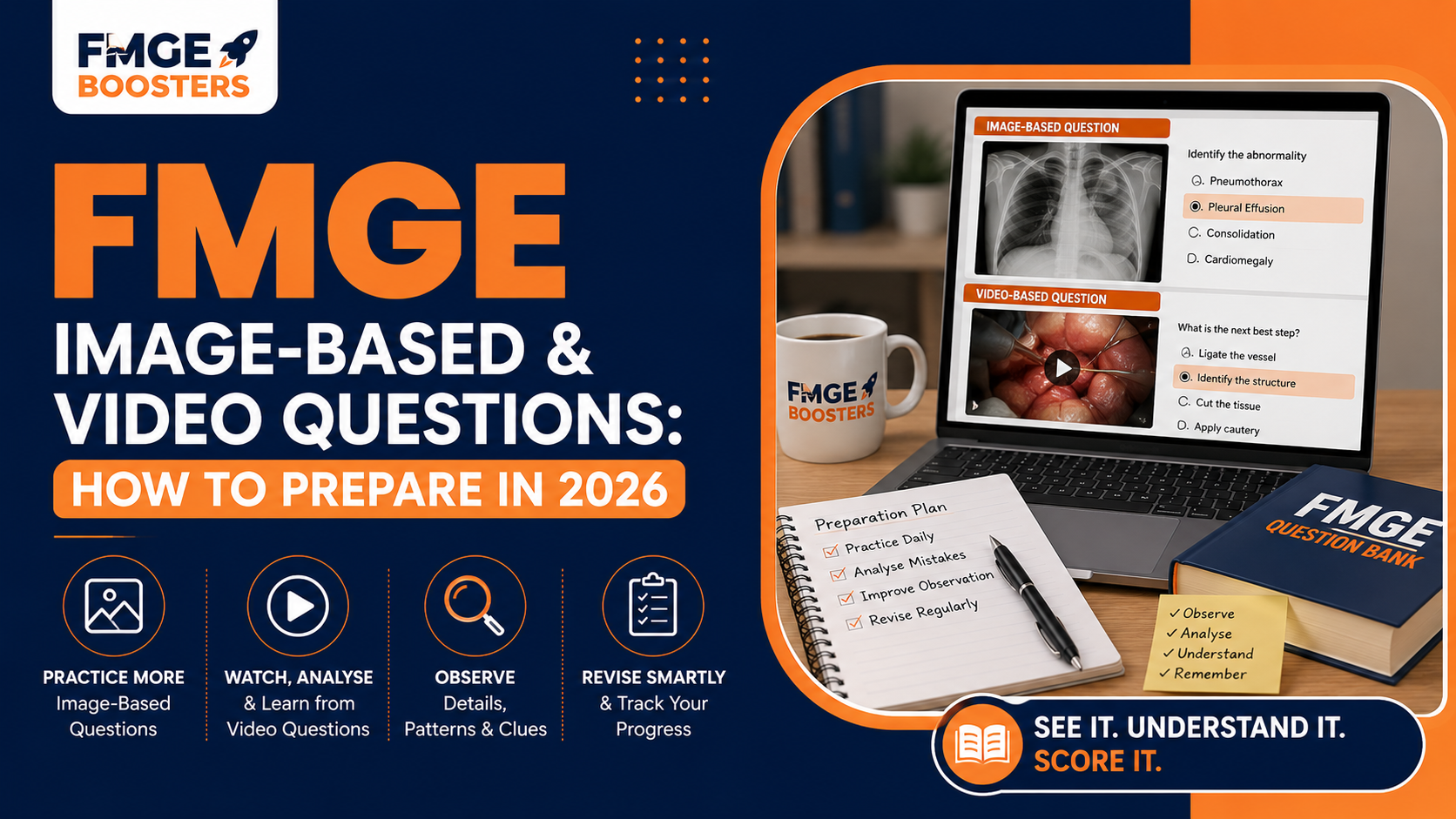
An image-based question gives you a visual clue instead of describing the entire clinical finding in words. The image could be a clinical photograph, radiological finding, pathology slide, ECG, surgical instrument, ophthalmic finding, dermatological lesion, or another clinical feature. The question may then ask you to identify the diagnosis, interpret the finding, choose the next investigation, or decide on the appropriate management. This means you need to recognise what you are looking at, not just remember its name from your notes.
For example, you may remember that a particular disease has a characteristic radiological finding. But when that image appears in the exam, you still need to identify the relevant feature and connect it to the disease. The same applies to clinical signs: do not just memorise that a condition is associated with a particular sign. Understand what the sign actually looks like, why it occurs, and what it tells you about the patient. This becomes even more important when the exam image looks different from what you studied. In clinical practice, the same disease can present differently across patients, so if you understand the underlying feature instead of memorising a single picture, you can still recognise the concept when the presentation changes. In other words, image-based questions test more than visual memory. They test whether you can recognise a clinical finding and apply what you know to it.
What are video-based questions in FMGE?
Video-based questions take the idea of image-based questions a little further. Instead of showing you a single image, you may be shown a short clinical video and then asked a question based on what you just saw. Candidates who appeared for the June 2026 FMGE reported seeing short clinical clips involving patient examinations, including an infant examination, clinical findings, and a forensic demonstration.
So what makes these questions different? You have to actually watch and observe what is happening. A patient may be showing a particular gait, abnormal movement, facial finding, breathing pattern, posture, or examination sign. You need to notice that finding first and then connect it to what you already know. This is why understanding signs and symptoms is so important. If you only remember that a particular disease is associated with a certain sign, seeing it in a video may not be enough. You should know what that sign looks like in a real patient, when it occurs, and what it tells you. You may read about a clinical sign in your notes, see it in an image, or watch it being demonstrated in a patient. The concept is the same; only the way you are being asked to recognise it has changed, and that is exactly what you need to prepare for.
How to prepare for FMGE image-based and video questions
You do not need a completely separate study plan for image-based and video questions. Instead, make your existing preparation more clinical and more connected.
Study through integration, not isolated subjects
A clinical question can start with something from Medicine and then make you think about Microbiology, Pathology, Radiology or Pharmacology. When you connect concepts while studying, you do not have to remember five separate things; you understand how they fit together.
Worked example: pneumonia
You revise its clinical presentation in Medicine, the causative organisms in Microbiology, the pathological changes in Pathology, the X-ray findings in Radiology, and the treatment in Pharmacology.
Now the question shows you an X-ray. You identify the finding and recognise pneumonia, but it may not stop there: it could ask the causative organism, the next step in management, a possible complication, or even the mechanism of action of the drug you would use. Understanding how these connect makes the question much easier.
Understand signs and symptoms, do not just memorise them
For video-based questions especially, do not just learn that a disease causes a particular sign. Ask what that sign actually looks like, when you would expect to see it, why it happens, and what it tells you about the patient. If you are studying a neurological condition, do not stop at the name of a gait abnormality; look at what that gait actually looks like and what it indicates.
Watch relevant clinical case videos
You may know the theory well but not have seen how a condition actually presents, and seeing it once can make more sense than reading about it ten times. When watching a case video, do not just sit back. Look at the patient, try to identify the finding before the explanation, and ask what the important finding is and what it could indicate. Then check the explanation. When that same finding appears in a question, you will not be seeing it for the first time.
Revise diseases as complete clinical pictures
When you revise a disease, do not stop at its definition, causes or treatment. Put the whole picture together: how the patient presents, what you would find on examination, which investigations help, what you would do next, and what complications to expect. Image and video questions often give you only one part of that picture, so if you understand the condition as a whole, you can use a single clue to work towards the answer.
How to practise image-based and video questions
Knowing what an image or video question can look like is only the first step. You also need to get comfortable solving them. When you see an image, take a moment to study it before looking at the options. Focus on the finding that stands out and use it to narrow down the possible diagnosis. The same approach applies to video-based questions: if you are practising with a clinical video, try to identify the important finding before checking the explanation, paying attention to the patient's movements, examination findings, or other clinical features.
Once you have identified the diagnosis, do not stop there. Use the same case to revise the related concepts: the causative organism, important investigations, treatment, complications, or relevant drug mechanism. This connects the visual clue with the rest of the clinical picture. You can also use your regular MCQs and mock tests for this. Whenever you come across an image-based or clinical question, spend time understanding why the answer is correct instead of simply checking whether you got it right. If you are struggling with how to approach clinical and application-based questions, our guide on how to solve FMGE MCQs can help you build a more structured approach.
Do not wait until the last few days to simply go through images and videos. Start practising these questions alongside your regular preparation. Instead of counting how many image-based questions you have solved, focus on how you are solving them: are you identifying the right finding, focusing on the relevant details, and applying the concept correctly? The quality of your practice matters more than the number of questions you complete.
Conclusion
Image-based and video-based questions may make a familiar FMGE concept look different, but the solution is not to change your entire preparation strategy. You need to understand your concepts well enough to recognise them in different forms. Revise the clinical presentation of diseases, understand signs and symptoms, connect concepts across subjects, and use clinical case videos to see how conditions actually present in patients. Most importantly, practise applying what you know. Do not just remember what a condition looks like in a textbook; learn to recognise it when you see it in an image, a video, or a clinical scenario. The June 2026 FMGE showed why this kind of preparation can be useful, so as you prepare for the next FMGE, make visual and clinical practice a regular part of your revision rather than something you leave for the last few days.
Ready to practise? Try image-based practice at FMGE Boosters and get more comfortable with the kind of visual questions you may encounter during your preparation.
Try image-based practice